Private Charter Meaning for Travelers: DOT Rules, Costs & Booking
- PCB Prestige

- 3 days ago
- 7 min read
A private charter is the rental of an entire aircraft for one trip, one paying party, and one guest list, with no seats sold separately to strangers. The charterer, not an airline schedule, decides the departure time, the route, and who’s on board. The U.S. Department of Transportation treats this as a fundamentally different category from scheduled commercial flying.
TL;DR:
Private charters involve renting an entire aircraft for a single trip, with the flight’s departure, route, and passenger list controlled exclusively by the charterer.
Most charters in the U.S. operate under FAA Part 135, which mandates strict crew rest, maintenance, and operational standards; verify the actual operator’s certificate before booking.
Costs vary based on aircraft type, flight and positioning fees, airport surcharges, and market-driven fuel and tax charges, often making charters more economical than ownership under 200 flight hours annually.
Booking requires clear communication, including verifying the operator’s license, itemized quotes, and confirming baggage, catering, and cancellation policies well before departure.
The main misconception about private charters lies in equating them with luxury status, when in fact they are mission-driven for control over schedule, guest list, and experience.
Table of Contents
Definition and essential features of a private charter
The DOT’s own language is precise: a charter flight is a non-scheduled operation where a group, company, or individual rents the whole aircraft rather than buying individual seats, and the charterer sets the departure and arrival times, origin, and destination. That single sentence explains why a film crew chasing a shoot location, a corporate team flying to three cities in one day, or a family heading to a remote fishing lodge might all charter the same type of airplane for very different reasons.
The defining feature isn’t luxury. It’s exclusivity of use. Whoever books the flight pays for the whole aircraft, controls the manifest, and has no obligation to anyone else’s schedule. A private jet charter booking covers one trip, and once it’s flown, the relationship between charterer and aircraft ends. No ongoing lease, no shared ownership.
That single-entity structure matters legally, not just practically. A charter booked by one company or family for its own invited guests is treated differently than a flight where a tour operator sells individual seats to the public. The distinction determines what protections apply and what a provider is allowed to advertise, which is the exact line the next section draws.
Private vs. public vs. semi-private: what you’re actually buying
Federal rules split charters into categories based on who pays and who’s invited, not the size of the plane.
Private charter: A single party engages the entire aircraft, invites its own passengers, pays the full cost, and the flight is not advertised or sold to the public. 49 CFR 1540.5 uses these exact markers to define it.
Semi-private or charter-by-the-seat: A newer hybrid where a company sells individual seats on smaller aircraft flying set routes, blending scheduled convenience with charter-style aircraft.
Jet cards and membership programs: Prepaid hour blocks or subscription-style access that lock in a rate and aircraft category without full ownership.
Empty-leg flights: Repositioning flights an operator needs to fly anyway, offered at a discount because the alternative is flying that leg empty. Great value if your dates are flexible; unreliable if they aren’t.
Knowing which bucket a quoted flight falls into tells you what rights and pricing structure you’re actually agreeing to.
How private charters actually work: who does what
Three types of businesses sit between you and the airplane, and mixing them up leads to bad assumptions about accountability.
Operators hold the actual FAA certificate and own or lease the aircraft. They’re legally responsible for the flight.
Brokers don’t own planes. They shop your trip across multiple operators and arrange the booking on your behalf.
Marketplaces and jet card companies package access to multiple operators’ aircraft, often trading flexibility for a locked-in rate, a trade-off worth weighing according to industry analysis on jet card economics.
In the U.S., most charter operations fly under FAA Part 135, the certification standard covering commuter and on-demand operators. Part 135 dictates crew rest rules, maintenance schedules, and operational oversight, which is the regulatory backbone behind the DOT’s consumer guidance.
Behind the scenes, a legitimate charter involves dispatch and flight-following, an assigned crew, and trip paperwork confirming the aircraft’s certification and insurance. If a broker can’t produce the actual operator’s certificate number, that’s a red flag worth walking away from.

Pro Tip: Always ask for the name of the certificated operator directly, not just the broker. A broker arranging your flight should hand you that name without hesitation. Reluctance to share it is a warning sign.
What private charters cost and what drives the price
Charter pricing isn’t a flat rate. It’s built from several stacking variables, and understanding them helps you read a quote instead of just reacting to the total.
Aircraft category and hourly rate. Turboprops run cheapest per hour, followed by light jets, midsize jets, and heavy jets, in roughly that order of cost.
Flight time and positioning. You often pay for the aircraft to fly to your departure airport empty before your trip even starts.
Airport and handling fees. Remote airstrips, international destinations, and airports with night curfews add surcharges.
Crew costs, catering, and amenities. Longer trips may require additional crew for rest requirements.
Taxes and fuel surcharges. These fluctuate with market conditions and can shift a quote significantly between booking and departure.
Chartering tends to beat ownership on total cost for travelers flying under roughly 200 hours a year, since owning an aircraft means paying for crew, hangar space, and maintenance whether you fly or not.
If cost is the deciding factor, ask about empty-leg availability, seat-sharing programs, or a jet card with a locked category rate. None of these fit every trip, but each can meaningfully undercut a standard one-off charter quote.
When to charter, when to fly commercial, when to just own
Charter earns its cost when your schedule, not the airline’s, needs to run the show. Tight multi-city itineraries, airports without commercial service, group moves where coordinating six separate tickets would be a logistical mess, or trips where privacy actually matters, these are the situations where paying for exclusive use makes sense.
Scheduled commercial flights still win on price for routine leisure travel, especially on high-traffic routes with frequent departures. If you’re flying twice a year to the same major city, a scheduled ticket beats chartering every time.
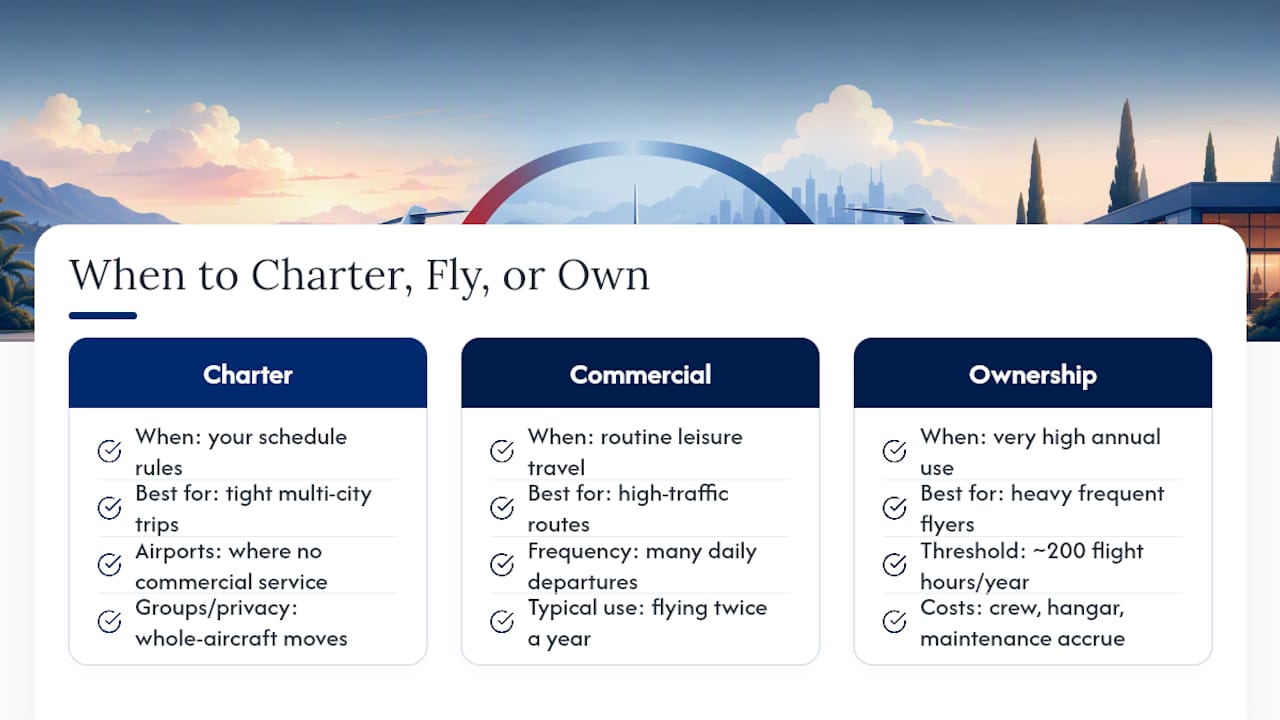
Ownership only pencils out past a certain usage threshold. The rule of thumb from charter-industry analysis holds that under roughly 200 flight hours annually, chartering costs less than owning once you account for crew salaries, hangar fees, and maintenance reserves that keep accruing whether the plane leaves the ground or not. Past that threshold, the math starts to favor a jet card or fractional share instead of pure charter.
How to book a private charter: the practical checklist
Define the mission. Passenger count, bags, dates, and whether flexibility on timing is possible.
Get quotes from at least two sources, ideally one operator and one broker, to compare pricing structures.
Verify the operator’s Part 135 certificate and confirm current insurance coverage.
Ask what’s included: repositioning legs, de-icing, catering, ground transport, overnight crew costs.
Confirm cancellation and weather-delay policy before signing anything.
Review the contract for the exact tail number or aircraft category guaranteed, not just a class name.
Expect final trip documents, passenger manifest, and crew details 24 to 48 hours before departure.
Pro Tip: Get every quote itemized the same way. A “flat” $8,000 quote that hides positioning fees isn’t actually cheaper than a $9,500 quote that discloses everything upfront.
The logistics of building a custom private itinerary aren’t unique to aviation. A private boat charter follows the same basic negotiation: exclusive use, a fixed price for your group only, and a captain or operator who answers directly to you instead of a shared schedule. Ground transport works the same way too, as this breakdown of luxury minibus charter for groups shows.
Why “private charter” gets misunderstood so often
Most people hear “private charter” and picture a status symbol. It’s really a mission-driven transport decision, the same logic that makes a family charter a boat instead of joining a crowded group tour. You’re not paying for prestige. You’re paying to control the guest list, the schedule, and the experience.
The single best vetting question isn’t about the plane, it’s about paperwork. Ask for the certificate number and confirm it independently before comparing prices, because two quotes that look apples-to-apples often aren’t once you check what’s actually included. That same principle of controlling your own guest list and schedule is exactly what drives demand for Pcbprestige’s private boat tours in Panama City Beach, where a licensed captain and a 26-foot boat serve one group at a time, not a full manifest of strangers.
— Justin
Sources
For the formal rules, start with the DOT’s charter flight guidance and Bureau of Transportation Statistics for complaint data. For the legal test separating private from public charter, see the Shackelford, McKinley & Norton analysis.
Ready to experience exclusive-use travel on the water instead of in the air? Explore Pcbprestige’s private tour options or reserve your private Shell Island snorkeling trip directly.
Charter Flights | US Department of Transportation
Recommended
Comments