U.S. Boat Tour Tipping: Dollar Cheat Sheet and Private Charter Tips
- PCB Prestige

- 2 days ago
- 10 min read
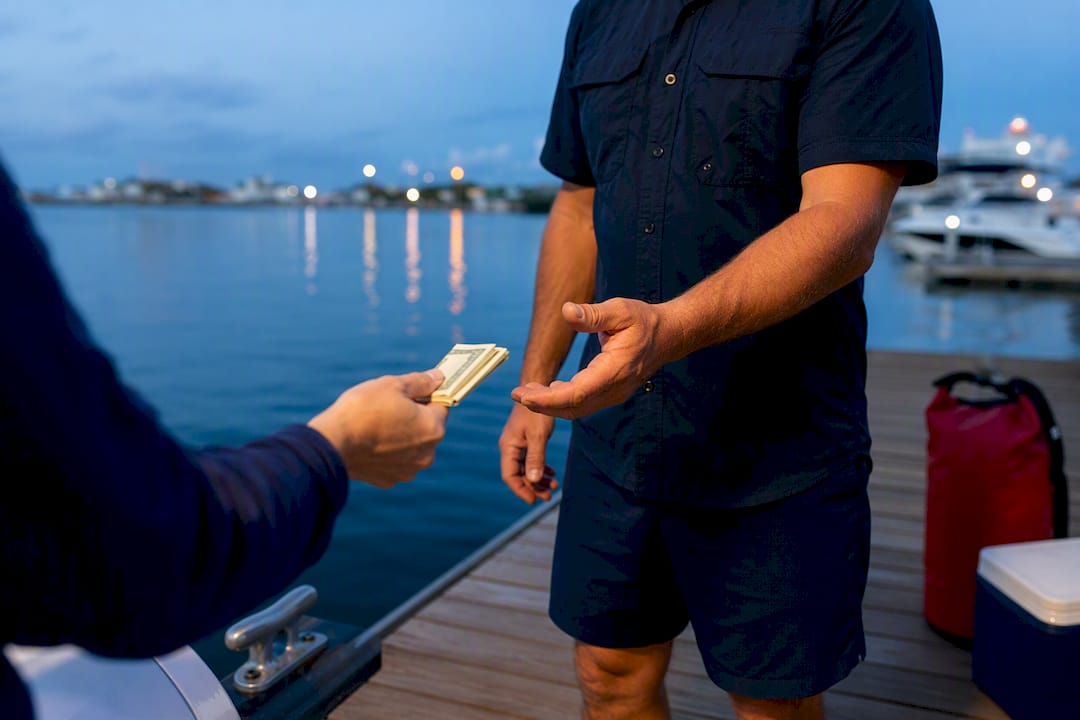
Yes, tipping is customary on captained boat tours, whether it’s a dolphin cruise, a fishing charter, or a sunset sail. The practical baseline is a moderate percentage of the trip cost, or a flat amount for short outings where percentages get fussy. Bring cash when you can, and confirm the operator’s gratuity policy before you assume it’s built into your bill.
TL;DR:
Tipping for captained boat tours typically ranges from 15% to 20%, with higher tips for exceptional service or memorable wildlife encounters.
Short trips under three hours often warrant a flat cash tip of $20 to $50, while longer or full-day trips should be tipped based on the trip cost and service quality.
Multi-crew experiences like party boats or luxury yachts may require 18% to 25%, with service complexity justifying the higher percentage.
Cash remains the preferred tip method for immediacy, but tipping via booking platforms is acceptable if confirmed that the crew receives the full amount.
Outside the US, tipping norms vary; some countries include service charges, and in places like Japan, tipping can be considered inappropriate or awkward.
Table of Contents
What Is Boat Tour Tipping Etiquette, Exactly?
Boat tour tipping etiquette is the set of customary rules travelers use to reward a captain and crew for a safe, well run trip. It works like restaurant tipping in that it’s expected but not legally required, and like tipping guides on a hiking trip in that the amount often depends on skill, personalization, and how physically demanding the day was for the crew. Unlike a sit-down dinner, there’s no printed percentage on the receipt to guide you. You’re making the call yourself, based on trip length, service quality, and how many crew members split the work.
Quick rules and standard tipping rates
Here’s the cheat sheet version, the one worth screenshotting before you leave for the dock.
Short trips (1 to 3 hours): $20 to $50 flat, especially for sightseeing, snorkeling, or a quick dolphin watch where a percentage would come out to pocket change.
Half-day trips (4 hours or so): 15% to 18% of the total cost.
Full-day charters: 15% to 20%, trending toward the higher end when the crew handles food, gear, and extra coaching.
Multi-day or luxury charters: 15% to 20%, sometimes higher on crewed yachts with dedicated stewards.
Dock hands or delivery staff: $10 to $20 for basic help, up to $50 if they haul gear, deliver a rental boat, or handle a tricky launch.
Discover Boating lists 15% to 20% as the standard range for captained charters, with 15% cited most often as the baseline figure industry-wide. That number holds up whether you’re on a two-hour excursion or a full-day trip, though the dollar amount obviously scales with the ticket price.
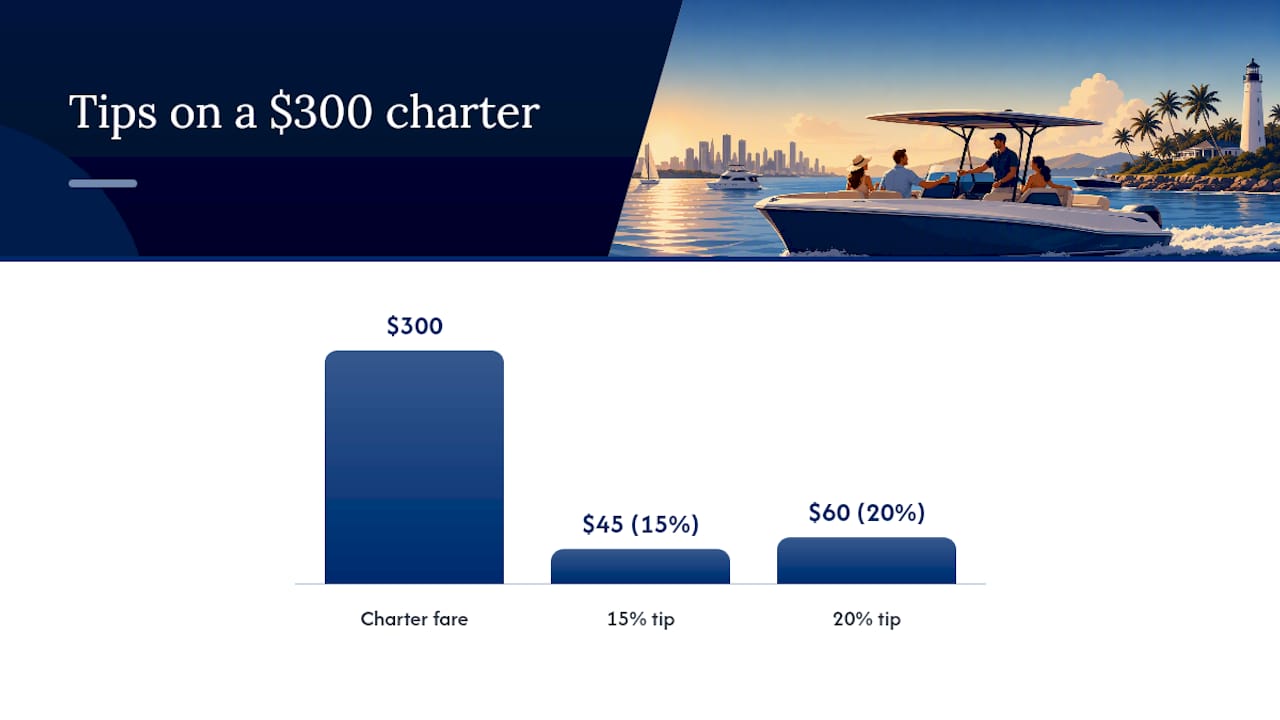
Quick stat: On a $300 charter, a 15% tip comes to $45, and 20% comes to $60. That’s the kind of gap worth thinking through before you hand over cash at the dock.
Tip toward the higher end when the captain went out of their way, spotted marine life you’d have missed on your own, handled a big group without missing a beat, or made a genuinely memorable moment happen, like maneuvering close enough for a great photo without disturbing wildlife. Tip toward the lower end, but still tip, when the weather cut the trip short through no fault of the crew, or when the outing was strictly functional with no extra effort involved.
How Much To Tip By Boat Type And Trip Length
Not all boat tours run the same way, and the tipping math shifts depending on what kind of trip you booked.
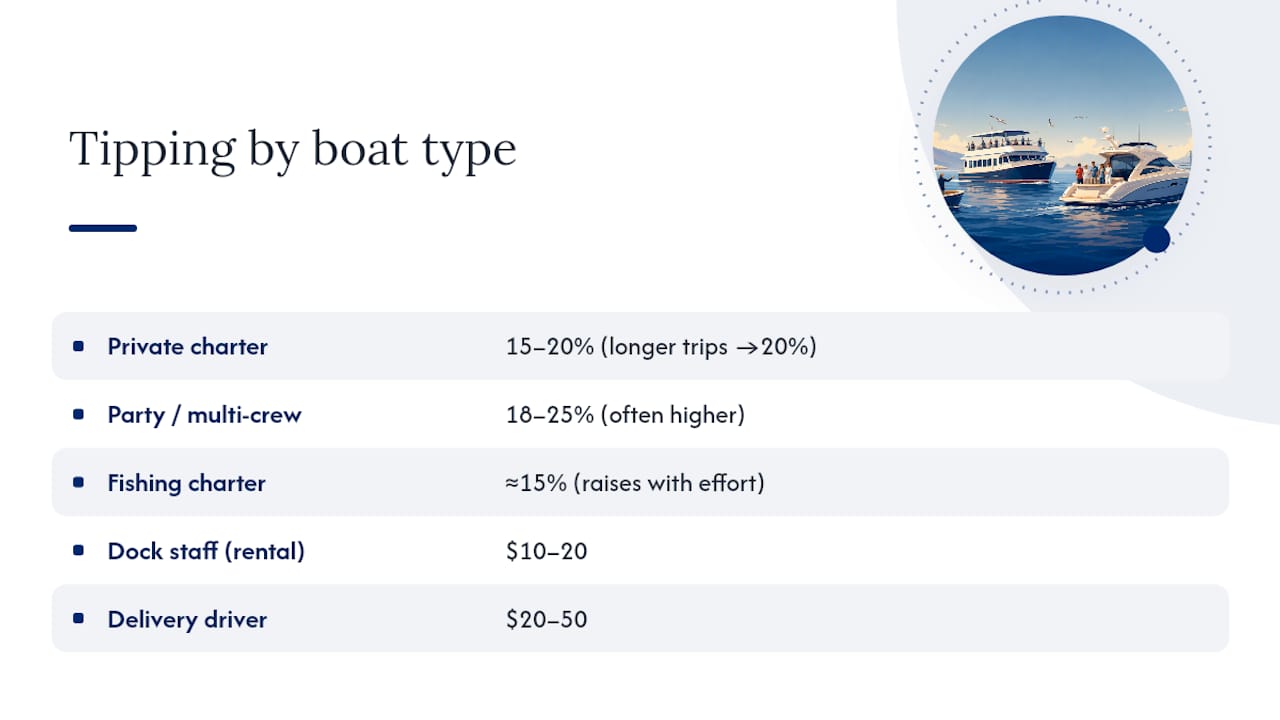
Captained private charters run on the standard 15% to 20% rule, and longer trips tend to land at the higher end of that range. A four-hour private charter demands more attention, more narration, and more physical work from the captain than a 90-minute jaunt, so the extra percentage reflects real effort, not just a longer invoice.
Party boats and multi-crew experiences often call for 18% to 25%, sometimes more. When you’ve got a captain, a mate, and maybe a deckhand all working the trip, that gratuity gets divided several ways. Tide Up Boat Rentals notes that multi-crew setups commonly land at the top of the tipping scale precisely because the service is more hands-on across a bigger group.
Fishing charters typically sit around 15%, the same baseline as sightseeing charters, but that number climbs when the guide puts in extra effort finding fish, rigging gear repeatedly, or running a longer day than originally planned. A guide who gets you into a great bite on a slow fishing day earns more than the standard rate.
Self-drive rentals flip the script entirely. Nobody expects a tip for a bareboat rental since there’s no crew providing service during the trip itself. What you do tip is the dock staff who prep the boat, walk you through safety basics, and handle the paperwork, along with any delivery driver who drops a boat at your dock or beach. Tide Up Boat Rentals suggests $10 to $20 for dock staff and $20 to $50 for delivery drivers, scaling with how much extra help they provide.
Here’s how those percentages translate into real dollars across common trip prices:
Those figures come straight from the standard percentage ranges Discover Boating and Tide Up Boat Rentals both point to, and they hold up across trip types once you know which end of the range fits your situation. Rounding up is standard practice. Nobody’s handing a captain exact change.
Cash, Card, Or Booking Add-On: How To Actually Give The Tip
Cash is still the gold standard on boats, and there’s a practical reason for it: crew members often split gratuities on the spot at the end of the day, and cash makes that instant. Bring small bills, a $20 or two folded in your pocket beats a single $100 bill you’re hoping someone can break at the dock.
If your booking platform offers a gratuity option at checkout, use it, but verify first that the amount actually reaches the crew rather than getting absorbed into the operator’s general revenue. NPR’s coverage of shifting tipping norms points out that more booking systems now build in gratuity fields, but distribution practices vary widely from one operator to the next. When in doubt, ask directly: “Does this tip go straight to the captain and crew?”
For splitting decisions:
On a single-captain trip, hand the tip directly to the captain.
On a multi-crew trip, give one combined tip to the captain to divide, which is the customary approach according to industry guidance from Tide Up Boat Rentals.
If one crew member went noticeably above and beyond, whether that’s a deckhand who spotted every dolphin or a mate who handled seasick passengers with real patience, tip that person individually in addition to the group tip.
Timing matters too. The end of the trip, after you’re safely back at the dock, is the standard moment to tip. A simple “thanks so much, this was a great trip” while handing over cash covers the etiquette completely. Nobody expects a speech.
Pro Tip: Keep a small stack of $20 bills in a separate pocket or zippered bag before you head to the marina. Fumbling through a wet backpack for cash at the dock is the fastest way to turn a smooth goodbye into an awkward one.
Prepaid Excursions, Included Gratuity, And Other Exceptions
Some situations don’t fit the standard rule cleanly, and it helps to know the exceptions before you’re standing on the dock trying to figure it out.
Prepaid shore excursions, the kind booked through a cruise line or resort concierge, usually leave tipping as optional but still customary. Check your confirmation email or excursion voucher. Some cruise-affiliated tours build a service charge into the upfront price, while others leave gratuity entirely up to you.
Included gratuity shows up more often than travelers expect, particularly on larger group tours or all-inclusive resort packages. Look for language like “gratuity included” or “service charge” on your booking confirmation. If it’s unclear, a quick email or phone call to the operator settles it fast, and it beats double-tipping or accidentally stiffing the crew.
Poor service deserves a fair, not punitive, response. If the trip fell short because of weather, mechanical trouble, or something else outside the crew’s control, a reduced tip still makes sense, since a smaller tip acknowledges the effort while reflecting a rougher day. Save the zero-tip response for genuine negligence or rudeness, which is rare on well-run operations.
Safety-critical moments flip the calculus in the other direction. If a captain cut a trip short for a legitimate safety reason, storm cells rolling in, engine trouble, a medical issue on board, that’s a moment to tip generously, not less. A captain who makes the tough call to end a trip early to protect passengers is doing their job exactly right, and the gratuity should say so.
Real Dollar Examples And Group-Splitting Scenarios
Numbers make this easier than percentages ever will, so here’s how it plays out across common trip sizes.
A $75 short snorkeling trip, split among 4 people: at 15%, that’s $11.25 total, or roughly $3 per person. Round up to $15 total for clean math.
A $150 three-hour private dolphin tour, split among 4 people: at 18%, that’s $27, or about $7 per person.
A $300 half-day charter, split among 6 people: at 20%, that’s $60, or $10 per person, an easy number for everyone to chip in.
An $800 full-day charter, split among 6 people: at 15%, that’s $120, or $20 per person; at 20%, it’s $160, or roughly $27 per person.
A three-hour private dolphin tour with a single captain usually lands cleanly in the 15% to 20% bracket, no splitting complications since there’s just one crew member to tip. A sunset cruise runs the same math, though groups often round up simply because the experience feels celebratory. Whatever the trip, doing the math before you board, even a rough mental estimate, beats scrambling for a calculator at the dock while everyone’s ready to head to dinner.
A Practitioner’s Note On Tipping For Private Charters
Small private charters work a little differently than big group boats, and it’s worth understanding why. On a private trip with one captain and occasionally a mate, tips typically go directly to the person or people running your boat that day, not into a shared pool spread across a dozen other trips happening simultaneously.
Gratuities matter more on these smaller operations because tips make up a meaningful share of a captain’s income when the crew is small and the trips are personalized. Bring cash if you can. If your booking confirmation offers a gratuity add-on, that works too, but a quick check of the confirmation details before your trip clears up exactly how it’s handled.
Private charters like the 3-hour private dolphin and snorkeling tour run with a single licensed captain, which simplifies the tipping decision considerably. No splitting math, no guessing who did what. Just one person to thank at the end of a good day on the water.
Cultural Differences In Boat Tour Tipping Around The World
Tipping norms shift dramatically once you leave the United States, and assuming American rules apply everywhere is a common mistake among first-time international travelers.
In the U.S. and much of the Caribbean, tipping crew members 15% to 20% is standard practice and genuinely expected as part of a captain’s income. Regional guidance from Hawaii confirms this pattern holds even within domestic tourism hotspots, where local operators still recommend cash tips in line with mainland norms.
Europe runs differently. In many Mediterranean and Northern European countries, service charges are often built into the charter price, and additional tipping, while appreciated, isn’t expected the same way.
In parts of Asia, particularly Japan, tipping can actually feel awkward or even mildly insulting in some contexts, since excellent service is considered the standard, not something requiring extra payment. Southeast Asian tourist destinations catering heavily to Western travelers, think Thailand or the Philippines, have adapted more toward expecting tips from foreign visitors even where it’s not a local custom.
The safest move anywhere outside the U.S.: ask your hotel concierge or the booking operator directly what’s customary before your trip.
When Tipping Isn’t The Local Custom: How To Handle It Gracefully
Offering a tip in a place where it’s not customary can create genuine discomfort for the person receiving it, sometimes even putting them in an awkward spot with local social norms or workplace policies.
If you sense hesitation when you offer a tip, a slight pause, a polite but firm decline, don’t push it. Insisting can come across as tone-deaf rather than generous. A simple “I understand, thank you so much for a wonderful trip” respects the local custom without making anyone uncomfortable.
Alternative ways to show appreciation when cash tipping isn’t the norm:
Leave a detailed, specific review online naming the captain or guide by name.
Ask if the company accepts thank-you notes or feedback forms that get shared with staff directly.
If food or drinks were part of the trip, bringing a small non-cash gift, local snacks or a six-pack, sometimes reads as more appropriate than money.
When you’re not sure whether tipping fits the situation, asking the operator directly, “Is gratuity customary here, or is there another way to show appreciation?”, solves the guesswork instantly. Most captains and guides will answer honestly, and that one question prevents an awkward moment on either side.
A Practical Final Word On Tipping Your Crew
That’s the rule I’d want in my pocket before any boat trip, and it holds up whether you’re on a two-hour dolphin tour or a full-day charter. Confirm the operator’s policy before you assume gratuity is included, since assumptions are where awkward moments happen. And if a captain genuinely made your day better, say so in a review with their name attached. That kind of recognition tends to matter more than people expect.
— Justin
Book A Private Tour Where Tipping Etiquette Is Simple
Private charters strip out the guesswork that comes with big group boats splitting tips six different ways. On a Pcbprestige private tour, you’ve got one licensed captain running your trip on a 26-foot powerboat built for up to six guests, so the tipping math from this guide applies cleanly: no crowd, no splitting confusion, just a straightforward 15% to 20% for the person who spent the day showing your family dolphins and calm snorkeling water off Shell Island.
Pcbprestige’s private dolphin and snorkeling tours run as fully private charters, meaning your gratuity goes to the captain who actually guided your trip, not a rotating crew across a dozen other bookings that day. Check your booking confirmation for gratuity details, or ask directly when you reserve. Ready to see Shell Island for yourself? Book your private tour and lock in a date before the season fills up.
Sources
Recommended
Comments