Zinc vs Titanium Sunscreen: Which Mineral Filter Wins?


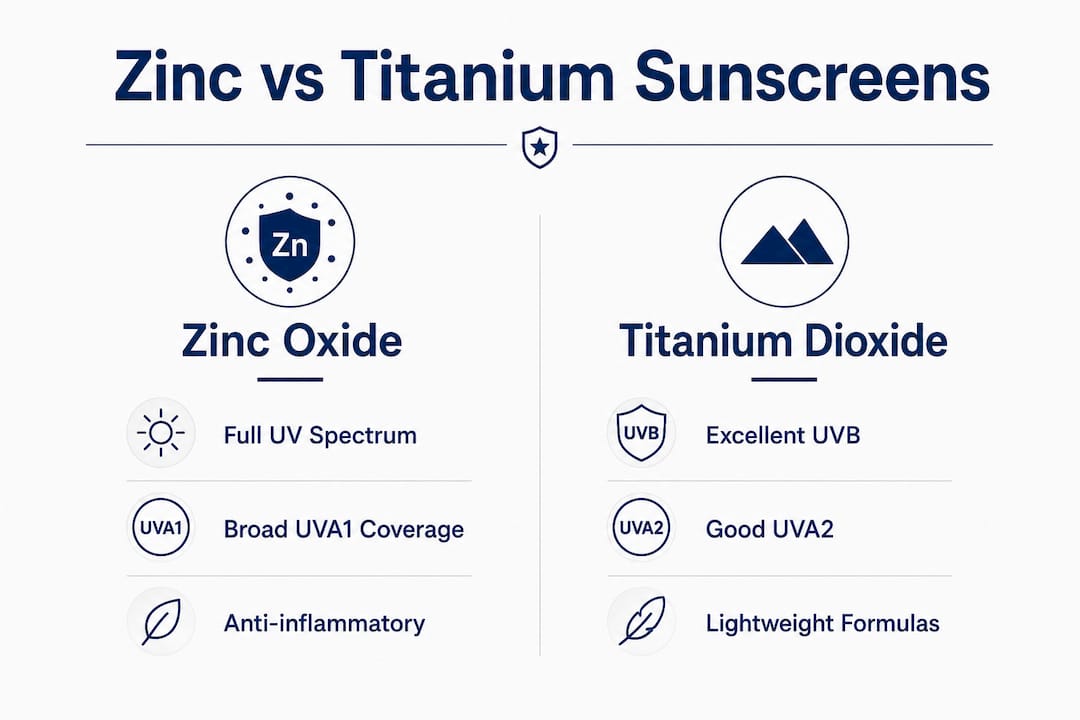
Zinc oxide is the stronger all-around mineral sunscreen ingredient. It covers the full UV spectrum, including UVA1 rays (340–400nm) responsible for photoaging and deeper skin damage, while titanium dioxide handles UVB and short UVA well but leaves a real gap in UVA1 protection. Both are FDA-approved mineral filters under OTC Monograph M020, permitted at concentrations up to 25%, and both sit on the skin surface rather than absorbing into the bloodstream. The practical takeaway: zinc oxide wins on spectrum, titanium dioxide wins on cosmetic elegance, and most high-performing formulas use both.
Feature | Zinc Oxide | Titanium Dioxide |
UVB protection | Good | Excellent |
UVA2 protection | Good | Good |
UVA1 protection (340–400nm) | Excellent | Poor |
White cast | More noticeable | Less noticeable |
Photostability | Stable | Stable |
Anti-inflammatory | Yes | No |
Reef safety (non-nano) | Yes | Yes |
FDA GRASE status | Yes | Yes |
Key differences at a glance:
Zinc oxide is the only single mineral ingredient that blocks the entire UVA and UVB range
Titanium dioxide delivers stronger UVB protection but misses deep UVA1 wavelengths
Combining both covers the full spectrum at lower concentrations, reducing white cast
Neither penetrates living skin layers in any meaningful amount
Both are photostable; neither degrades under prolonged sun exposure
How does UV spectrum coverage differ between zinc oxide and titanium dioxide?
Zinc oxide has a flat absorption curve across the entire UVA and UVB spectrum. That consistency is what makes it the preferred ingredient for photoaging prevention. UVA1 rays penetrate clouds, pass through car windows, and reach deeper into skin than UVB, driving collagen breakdown, pigmentation, and long-term melanoma risk. Titanium dioxide’s absorption shifts toward a predominantly UVB spectrum as particle size decreases, leaving UVA1 largely unaddressed.

The practical consequence: a sunscreen built on titanium dioxide alone is not genuinely broad-spectrum. It will prevent sunburn effectively, but it won’t stop the slower, deeper damage that shows up as premature wrinkles and dark spots years later. Zinc oxide, by contrast, covers UVA1 well even in nanosized form, which is a meaningful advantage when formulators reduce particle size to improve transparency.
When used together, the two minerals cover the full UV range with complementary strengths. Titanium dioxide handles UVB with more efficiency, zinc oxide anchors the UVA1 end, and the combination allows lower concentrations of each, which directly reduces the white cast that makes people abandon mineral sunscreen.
Protection profile summary:
Zinc oxide: broad, flat absorption from UVB through UVA1
Titanium dioxide: strong UVB, moderate UVA2, poor UVA1
Nano titanium dioxide loses UVA1 coverage faster than nano zinc oxide as particle size shrinks
Combination formulas deliver the most complete broad-spectrum defense
UV Range | Zinc Oxide | Titanium Dioxide |
UVB | Good | Excellent |
UVA2 | Good | Good |
UVA1 (340–400nm) | Excellent | Poor |
Are zinc oxide and titanium dioxide safe? What about nanoparticles?
Both ingredients carry FDA GRASE classification at concentrations up to 25%, a status that has held through the 2021 OTC Monograph M020 review. Multiple absorption studies confirm that neither zinc oxide nor titanium dioxide penetrates beyond the stratum corneum (the outermost skin layer) in any meaningful amount, making systemic toxicity from topical use extremely unlikely.
Nanoparticles, defined as particles under 100nm, are where the nuance lives. They improve cosmetic elegance by reducing white cast, but they raise legitimate questions about skin penetration on damaged skin. The consensus from current research is that nanoparticles don’t penetrate beyond the outer skin layer during normal topical application. The real concern is inhalation.
The European Commission acted on this by banning titanium dioxide in powder and spray cosmetic products due to inhalation carcinogenicity concerns. Critically, this restriction does not apply to sunscreen lotions applied to skin. The EWG similarly recommends avoiding spray or powder sunscreens containing either mineral in nanoparticle form.
Safety considerations:
Both are GRASE at up to 25% concentration in the US
Dermal absorption is minimal on intact and even tape-stripped skin
Spray and powder formats carry inhalation risk; lotion formats do not
Non-nano zinc oxide and titanium dioxide are considered reef-safe, approved under Hawaii and Key West reef-protection frameworks that ban oxybenzone and octinoxate
Zinc oxide has documented anti-inflammatory properties, making it suitable for sensitive skin, acne-prone skin, and use during pregnancy
Mineral sunscreens provide instant protection on application, unlike chemical filters that require a 15–30 minute activation period
How do zinc oxide and titanium dioxide compare cosmetically?
Titanium dioxide is easier to formulate into lightweight, transparent products. Its particles spread more readily and tend to leave less visible residue than zinc oxide at equivalent concentrations. Zinc oxide at higher concentrations (above 15%) produces a noticeably chalky layer, most visible on medium and deeper skin tones.

The white cast issue comes down to physics. Both minerals have high refractive indexes, with titanium dioxide at 2.6 and zinc oxide at 1.9, which means both scatter visible light and appear white on skin. Titanium dioxide’s higher refractive index actually makes it more whitening in theory, but its superior spreadability and lower typical use concentrations often result in a less visible cast in practice. Reducing particle size below 200nm decreases visible light scattering, which is why nano formulations look more transparent. The trade-off, as noted above, is reduced UVA1 coverage for titanium dioxide specifically.
Modern formulation approaches address the white cast problem in three ways: micronized or nano-sized particles, silica or silicone coatings that improve dispersion, and tinted pigments using iron oxides. Tinted mineral sunscreens do more than neutralize the chalky look. Iron oxides block visible light in the 400–450nm range, providing protection against high-energy visible light that contributes to hyperpigmentation in Fitzpatrick skin types III through VI, a range neither zinc oxide nor titanium dioxide touches on its own.
Cosmetic Factor | Zinc Oxide | Titanium Dioxide |
White cast tendency | Higher | Lower |
Texture | Thicker at high % | Lighter, more spreadable |
Formulation ease | More challenging | Easier |
Tinted formula benefit | High | Moderate |
Visible light protection | No | No |
Formulation and application tips:
Combination formulas let formulators run lower concentrations of each, reducing overall white cast
Tinted iron oxide formulas neutralize white cast and add visible light protection for deeper skin tones
Silica-coated particles improve dispersion and reduce photocatalytic reactions
Nano zinc oxide retains better UVA1 coverage than nano titanium dioxide when particle size is reduced for transparency
How to choose the right mineral sunscreen for your skin and activities
The right choice depends on what you’re protecting against and what you’ll actually wear consistently.
For photoaging and comprehensive UV defense: Choose a zinc oxide-dominant formula. Zinc oxide’s anti-inflammatory properties also make it the better pick for sensitive, reactive, rosacea-prone, or acne-prone skin. It’s the recommended choice during pregnancy, since neither zinc oxide nor titanium dioxide absorbs into the bloodstream, unlike some chemical filters that have been detected in blood plasma.
For lightweight daily wear: A titanium dioxide-forward formula or a combination product with a lower zinc oxide percentage (8–12%) delivers solid UVB protection with a lighter feel. For oily or combination skin, titanium dioxide’s lighter texture tends to feel less occlusive.
For outdoor activities like boating, snorkeling, or extended beach time: A combination formula with zinc oxide at 15–20% and titanium dioxide at 5–8% covers the full spectrum and holds up to water exposure. Non-nano formulations are the right call for reef-sensitive environments. If you’re heading out on the water in Panama City Beach, where you’ll be in direct sun for hours, this is the category that matters. Guests on private snorkeling tours should apply mineral sunscreen 15–30 minutes before boarding and reapply every two hours.
For medium to deep skin tones: A tinted mineral formula with iron oxides solves the white cast problem while adding visible light protection that addresses hyperpigmentation concerns.
Concentration guidelines by use case:
Daily incidental exposure: zinc oxide 8–12%, titanium dioxide 4–6%, expected SPF 30–40
Extended outdoor activity: zinc oxide 15–20%, titanium dioxide 5–8%, expected SPF 40–50+
Reef-safe beach use: zinc oxide 15–22% non-nano, titanium dioxide 5–8% non-nano, SPF 30–50
Post-procedure or compromised skin: zinc oxide 15–25% non-nano, titanium dioxide optional
For families planning Florida Panhandle outdoor tours, a non-nano combination mineral sunscreen applied generously before sun exposure covers both protection and reef safety in one product.
Spending a day on the water? Pcbprestige has you covered

Sun protection is non-negotiable on the Gulf. Pcbprestige runs private dolphin watching tours, Shell Island snorkeling trips, and sunset cruises out of Panama City Beach aboard a 26-foot powerboat with a licensed captain. Groups stay small, itineraries stay flexible, and the wildlife interactions stay ethical. Pack a non-nano mineral sunscreen, and book your private tour to spend the day on the water the right way.
Key Takeaways
Zinc oxide provides broader UV protection than titanium dioxide, covering UVA1 rays that drive photoaging, while combining both minerals delivers the most complete and cosmetically wearable mineral sunscreen.
Point | Details |
Zinc oxide covers more spectrum | It protects UVB through UVA1 (340–400nm); titanium dioxide misses UVA1 almost entirely. |
Both are FDA GRASE at up to 25% | Neither ingredient is absorbed into the bloodstream in meaningful amounts during topical use. |
Spray formats carry inhalation risk | Lotion formulas are safe; powder and spray products with nanoparticles raise respiratory concerns. |
Combination formulas outperform single-mineral products | Using both minerals at lower concentrations covers the full UV range with less white cast. |
Tinted iron oxide formulas solve the white cast problem | They also add visible light protection relevant to hyperpigmentation in deeper skin tones. |
Recommended
Comments