The Stingray Shuffle: How to Stay Safe Wading

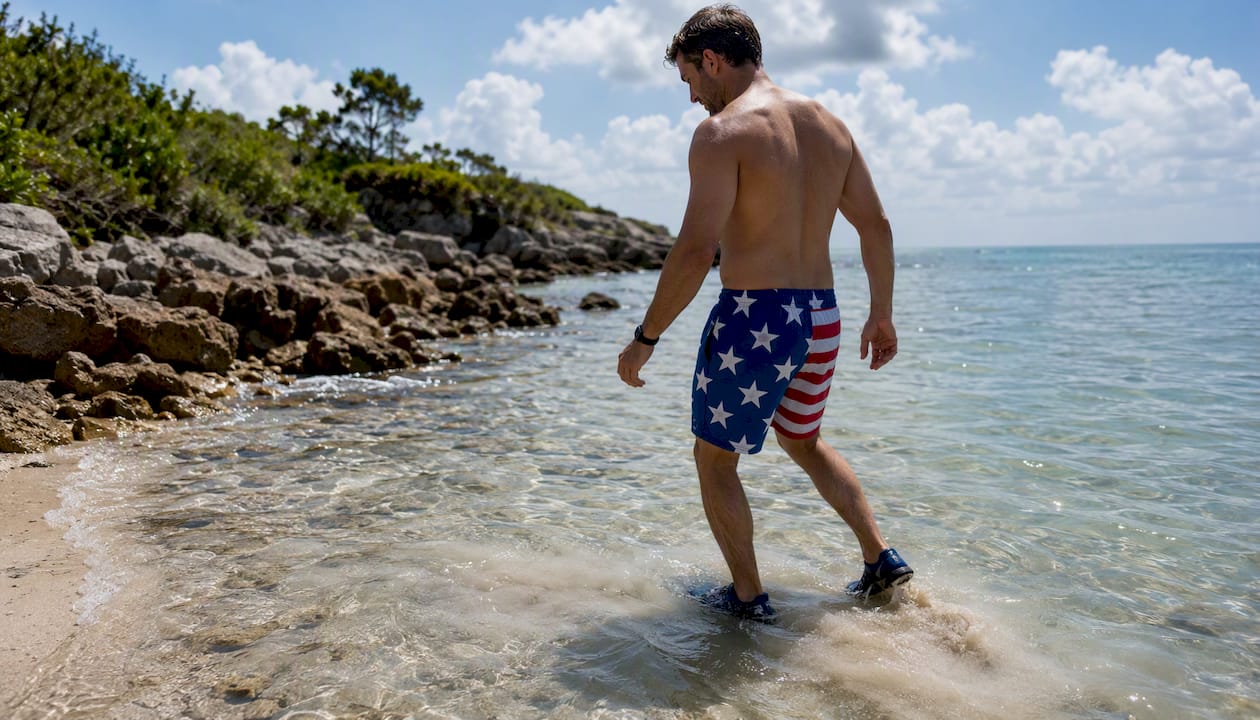
The stingray shuffle is a simple wading technique that cuts your risk of a sting dramatically: instead of lifting your feet, you slide them along the sandy bottom to create vibrations that warn buried rays so they can swim away. If you do get stung, get out of the water immediately and soak the wound in hot water until the pain eases.
If you are stung, do this right now:
Exit the water calmly and sit somewhere safe.
Soak the wound in hot water, ideally 110–113°F (43–45°C), for 30–90 minutes or until the pain eases.
Seek medical attention if pain does not improve, the wound is deep, or you feel dizzy, short of breath, or nauseous.
Table of Contents
What is the stingray shuffle and why does it work?
The stingray shuffle means sliding or dragging your feet along the sandy bottom rather than picking them up and stepping down. That motion sends vibrations through the sand, and stingrays respond by swimming away before you ever reach them.
Stingrays spend a lot of time buried just under the surface of shallow sand, with only their eyes and tail visible. They are not aggressive. They sting purely in self-defense, and only when they feel pinned and have no escape. The shuffle replaces a sudden, crushing footstep with a slow, steady vibration that gives the ray a half-second warning, which is exactly what it needs to flee rather than fight back.
Pro Tip: Think of the shuffle as knocking before you enter. You are not scaring rays away — you are giving them a polite heads-up.
UF/IFAS extension educators recommend the technique as a practical, low-effort prevention measure for anyone wading in shallow, sandy water.
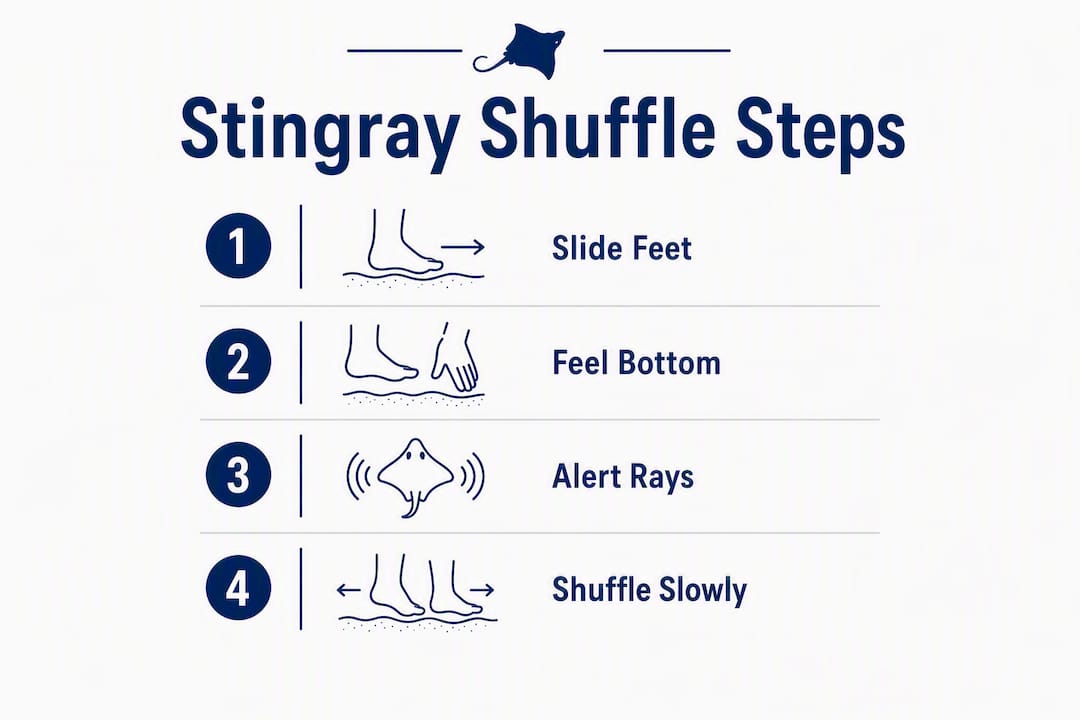
How to do the stingray shuffle correctly
Done right, the shuffle is easy. Done wrong, it barely helps.
Start at the water’s edge. Before your feet leave dry sand, commit to the technique. Do not wait until you are knee-deep.
Keep both feet in contact with the bottom. Slide one foot forward along the sand, then drag the other up to meet it. Think of it as a slow, flat-footed skating motion.
Move at a steady, unhurried pace. Fast movement reduces the vibration window. Slow and deliberate is the goal.
Keep your weight low. Slightly bent knees help you feel the bottom and react if you sense something moving underfoot.
Shuffle through waves, not over them. When a wave pushes you, keep your feet planted and let the water move around you. Hopping or skipping to stay balanced defeats the purpose.
Common mistakes to avoid:
Lifting your feet completely off the bottom between steps.
Taking long, confident strides as if you were walking on a sidewalk.
Running or jogging through shallow water.
Stopping the shuffle once you are past waist depth (rays can be in surprisingly deep water near shore).
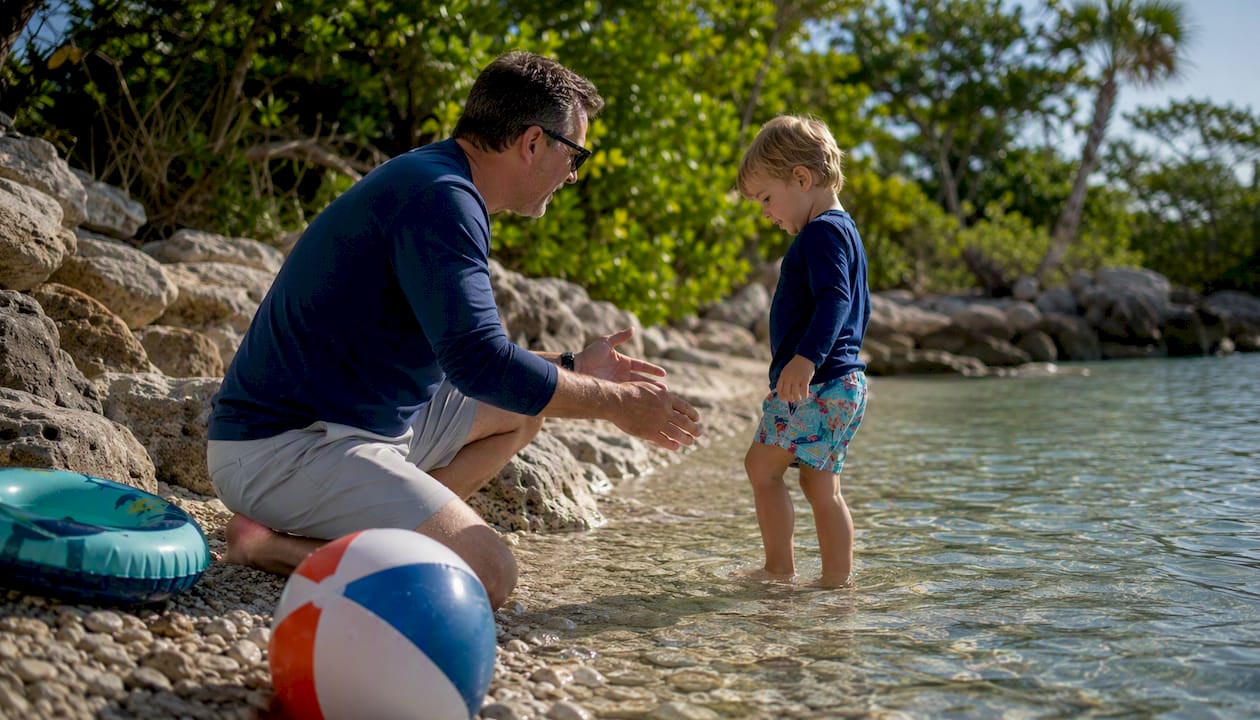
Coaching children: Get down to their level and show them the motion before you enter the water. A short
is worth watching with kids before a beach trip. Make it a game — “penguin walk” or “moon walk” tends to stick better than “shuffle.”
Pro Tip: In murky or low-visibility water, slow down even more and keep your group close together. Spread-out groups create gaps where someone stops shuffling without realizing it.
When and where should you shuffle?
Not every stretch of water carries the same risk. The shuffle matters most when several conditions line up.
Shuffle whenever you are wading ankle-to-thigh deep over a sandy bottom. That is the zone where rays bury most often. Add any of the following and the risk climbs: summer months (June through September in the Gulf), low tide, warm water, or murky conditions where visibility near the bottom is poor. Stingrays concentrate in shallow warm surf zones and estuaries, especially at lower tides when they settle into the sand to rest and feed.
Locals in Florida recommend shuffling even in just a few inches of water, because rays commonly bury themselves within a few yards of the shoreline at low tide.
Exceptions: Rocky or reef bottoms do not support buried rays the same way sand does, so the shuffle is less relevant there. Deep water (chest-deep or beyond) is generally lower risk for this specific hazard, though other cautions apply. Always check posted beach warnings before entering.
For broader water-safety context at Panama City Beach, the rip current guide at PCB covers the other major hazard families and small groups should know before wading.
How effective is the shuffle, and what are its limits?
The technique works, but it is not foolproof. CSULB research found that a stingray strikes about 85% of the time when pinned directly underfoot, compared to roughly 5% when stepped on at the edges or brushed. The shuffle aims to keep you in that second category, or better, to alert the ray before contact happens at all.
Scenario | Strike probability |
Ray pinned directly underfoot | ~85% |
Ray stepped on at edges / brushed | ~5% |
A popular-media video analysis by Surfer magazine put the shuffle’s real-world success rate at approximately 42.86% in a limited case-study sample. That number reflects specific filmed encounters, not a controlled study, but it is a useful reality check: the shuffle reduces risk significantly, it does not eliminate it.
Where the technique falls short:
Very small rays buried in extremely fine sand may not feel faint vibrations from a light shuffle.
High turbidity (churned-up, sandy water after storms) can mask both your movement and the ray’s position.
Beachgoers who shuffle inconsistently, stopping and starting, create unpredictable pressure patterns.
Groups where one person stops shuffling to point at something can step down hard without thinking.
The tail strike happens within roughly half a second of a ray being pinned, which is why the vibration warning has to come before full contact. There is no reaction time once a foot lands flat on a buried ray.
If you are stung: immediate first aid and when to seek medical care
Stay calm. Most stingray stings are painful but not life-threatening when treated promptly.
Get out of the water. Do not try to treat the wound while standing in surf.
Control bleeding. Apply gentle pressure with a clean cloth. Remove any visible spine fragments carefully, but do not dig into the wound.
Soak in hot water immediately. This is the most effective field treatment. Hot water denatures the protein-based venom and provides significant pain relief.
Rinse and loosely bandage the wound once pain has eased.
Monitor for infection over the following days. Stingray wounds carry a real infection risk.
Hot-water treatment guidance
Use clean tap water heated to a comfortably hot temperature and soak until the pain improves.
Visit Florida’s guidance confirms hot-water immersion as the primary recommended field treatment. Ice is not a substitute — it does not address the venom mechanism.
Go to an emergency room if you notice any of the following:
Pain that does not improve after 30–60 minutes of hot-water soaking.
Wound to the chest, neck, abdomen, or face.
Signs of systemic allergic reaction: difficulty breathing, swelling of the throat, rapid heartbeat, or loss of consciousness.
A deep puncture wound or suspected retained barb.
Signs of infection in the days after: increasing redness, warmth, swelling, or discharge.
Follow up with a doctor about tetanus if your vaccination is not current. For comparison, jellyfish sting treatment follows a different protocol — do not apply hot water to a jellyfish sting.
This article provides general safety information, not medical advice. Confirm treatment protocols with a healthcare professional or your local emergency services.
Quick beach-wading safety checklist before you enter the water
Before you wade in, run through these five points:
Check posted signs. Lifeguards and beach management post stingray warnings when activity is high.
Shuffle from the first step. Do not wait until you are ankle-deep to start.
Avoid stirring up the sand unnecessarily. Splashing and churning the bottom reduces your visibility and disturbs the habitat.
Watch children closely. Kids tend to run, hop, and splash — exactly the behaviors that increase sting risk. Keep them within arm’s reach in shallow water, and check out family-friendly Panama City Beach tips for safer activity ideas.
Time your wading. Avoid low tide during summer months if you want the lowest possible encounter risk.
Gear that actually helps
Water shoes are the most practical protective option. A thick-soled pair reduces puncture depth if you do step on a ray. They will not prevent a sting entirely, but they reduce severity.
Neoprene leggings or dive skins add a layer of protection for the lower leg and ankle, which is where most stings land. Useful for frequent waders, snorkelers, and anyone with kids who are hard to keep shuffling.
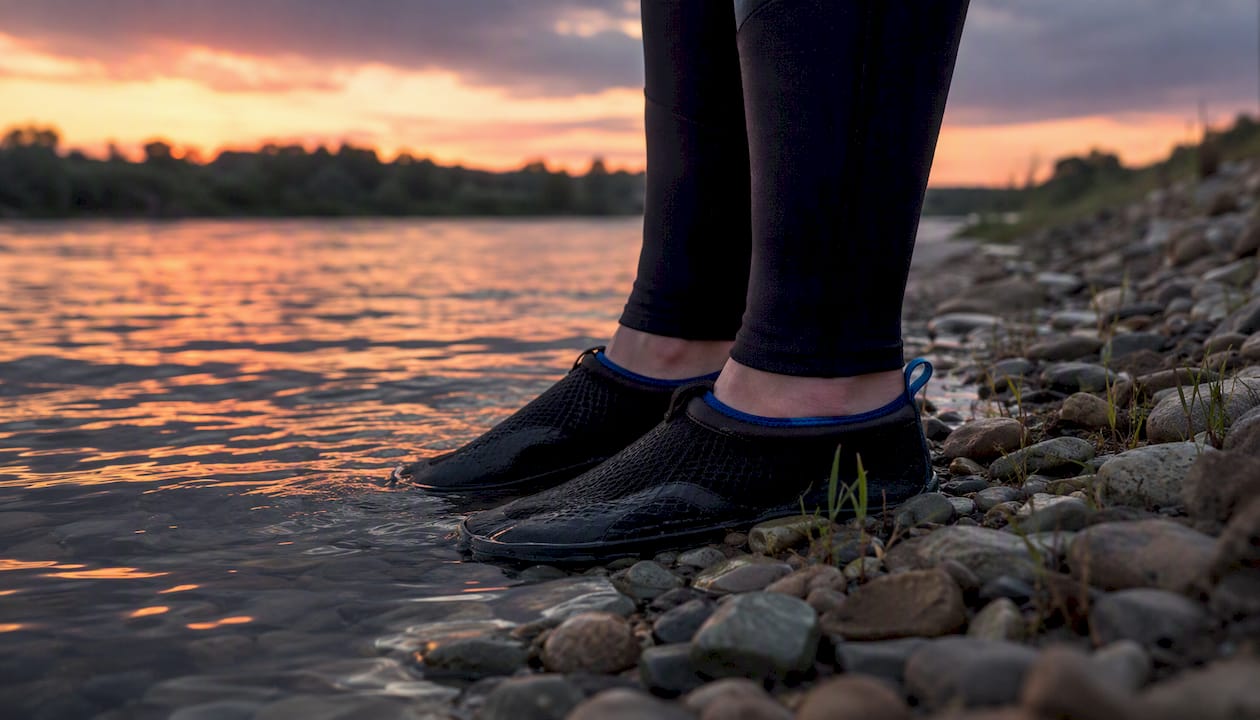
Neither option replaces the shuffle. Think of gear as a backup, not a substitute.
Pro Tip: Bring a small thermometer to the beach if you are traveling with young children. Guessing water temperature for a hot-water soak is harder than it sounds — a $10 kitchen thermometer takes the guesswork out of first aid.
What Panama City Beach captains and guides say
Local knowledge matters here. Captains who work the waters around Panama City Beach and St. Andrews Bay see stingray behavior up close, season after season.
That seasonal pattern holds across the Gulf Coast. Local news coverage near Panama City Beach has documented stingray activity close to shore, a reminder that these animals are a consistent part of the near-shore ecosystem, not a rare event.
Guides on private tours also have a practical advantage: they know which areas have higher ray concentrations on a given day, and they keep guests on the boat or in deeper, monitored water rather than wading through unknown shallows. For a deeper look at local stingray species and behavior, the St. Andrews Bay stingray guide covers what you are likely to encounter in these specific waters.
For broader coastal safety practices along the Florida Panhandle and nearby Destin area, this regional safety guide covers water-spot precautions worth knowing before you go.
Key Takeaways
The stingray shuffle works because it replaces a sudden pinning step with a gradual vibration that gives buried rays time to escape before contact occurs.
Point | Details |
Shuffle every step in shallow sand | Slide feet along the bottom in ankle-to-thigh-deep water, especially in summer at low tide. |
Hot water is the first-aid priority | Soak a sting in 110–113°F (43–45°C) water for 30–90 minutes; ice does not work on protein-based venom. |
Know the emergency signs | Seek immediate care for chest/neck wounds, breathing difficulty, or pain that does not improve. |
Gear helps but does not replace technique | Water shoes reduce puncture depth; neoprene leggings protect ankles, but neither substitutes for shuffling. |
Pcbprestige keeps you off the sand | Private boat tours from Pcbprestige let families view marine life safely without wading through stingray habitat. |
The shuffle is worth doing, but perspective matters
The stingray shuffle gets treated like a magic shield, and that framing does beachgoers a disservice. The technique is genuinely effective at reducing the most dangerous scenario — a direct pin — but the Surfer case-study data is a useful corrective. Real-world conditions are messier than a controlled shuffle. Kids stop paying attention. Adults get distracted by waves. Groups spread out.
What the shuffle actually does is shift the odds. It moves you from the 85% strike zone to something much lower. That is worth doing every time you wade. But it works best when paired with honest awareness of conditions: time of year, tide, water clarity, and how much you can realistically supervise everyone in your group.
The beachgoers who get stung most often are not the ones who forgot the technique. They are the ones who shuffled for the first ten steps and then stopped thinking about it. Consistency is the whole game.
See Panama City Beach marine life without the risk of wading
Pcbprestige runs private dolphin watching and snorkeling tours out of Panama City Beach on a 26-foot powerboat, captained by a licensed local expert. You get the dolphins, the marine life, and the Gulf Coast scenery without setting foot in unknown shallows.

Every charter is fully private, up to six guests, with snorkel gear included and flexible itineraries built around what your group actually wants to see. The captain knows where the rays are concentrated on any given day, which means your family spends the trip watching wildlife rather than worrying about what is underfoot.
Book your private tour and let the captain handle the local knowledge.
Useful sources for further reading
Visit Florida: The Stingray Shuffle — Clear overview of the technique and first-aid guidance from Florida’s official tourism authority.
UF/IFAS Extension: Doing the Stingray Shuffle — University of Florida extension educators explain the science and recommend the shuffle for Florida coastal visitors.
Long Beach Post: CSULB Research Findings — Covers the university research behind the 85% vs. 5% strike probability data and explains the behavioral mechanics.
Surfer Magazine: Does the Stingray Shuffle Work? — A real-world video analysis that tempers expectations and explains where the technique falls short.
St. Pete Beach, FL: Stingray Shuffle — Local government resource with concise public guidance for Gulf Coast beachgoers.
Pcbprestige: Stingrays of St. Andrews Bay — Local species and habitat guide specific to the Panama City Beach area; consult before wading in St. Andrews Bay. For current conditions, check with local lifeguards on duty.
Recommended
Comments