Dolphins at Sunset: Best Times, Photo Tips & Tours

Updated: 5 days ago
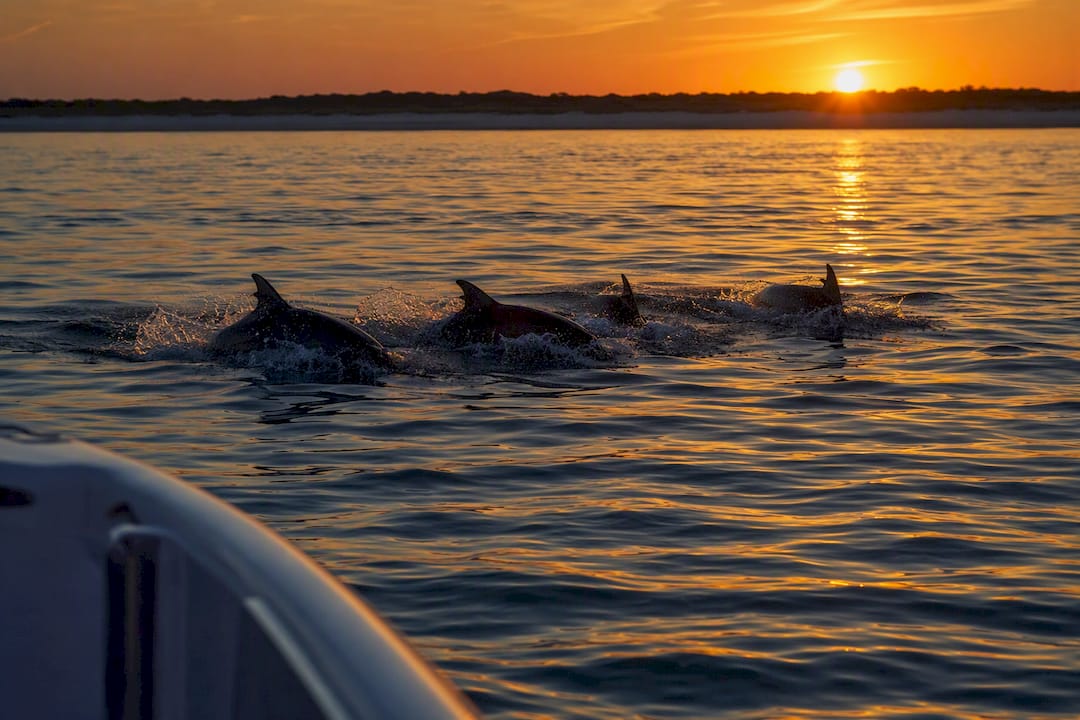
Yes, sunset is one of the best windows to see and photograph dolphins, but it’s not a guarantee. Low, golden light makes dorsal fins and spouts far easier to spot against the water, and dolphins are often actively feeding as afternoon shifts into dusk. Whether you actually see them still comes down to tide, wind, and how well your captain reads the local water.
Here’s what matters most before you plan around it:
Sighting odds: Late afternoon and dusk rank among the two daily activity peaks, alongside early morning, according to research on dolphin activity patterns.
Photo payoff: Golden hour light adds contrast and warm tones that make silhouettes, splashes, and breaches far more dramatic than midday shots.
Booking tip: Check the tide chart and wind forecast before you lock in a time. Moving water beats a fixed clock time almost every trip.
Dolphins are wild animals with their own schedule, so no operator can promise a sighting. What a good one can promise is a route built around the conditions most likely to produce one.
Key Takeaways
Sunset works so well for dolphin watching because golden-hour light improves visibility right as late-afternoon feeding activity peaks, provided the tide is moving.
Point | Details |
Sunset is a strong window | Late-afternoon and dusk rank among the two daily activity peaks, alongside early morning. |
Tide beats the clock | Check tide charts before booking, since moving water concentrates baitfish more reliably than any fixed time. |
Golden hour improves photos | Low, angled light sharpens fin and spout contrast and produces striking silhouettes in the last 60 minutes before sunset. |
Arrive 60 to 90 minutes early | Departing before sunset lets you catch peak light and the tail end of feeding activity into dusk. |
Private charters maximize odds | Pcbprestige times routes to tidal corridors with a licensed captain and small groups for better sightings and photo angles. |
Table of Contents
Why Dolphins at Sunset Look So Different
Midday sun creates flat, high glare that washes out the water’s surface. As the sun drops, light comes in low and angled, and that single shift changes everything about what you can actually see. Dorsal fins, blow spouts, and small surface disturbances suddenly stand out in sharp relief instead of disappearing into glare. It’s the same reason a photographer avoids shooting portraits at noon.
Behavior lines up with the light. Dolphins in the region tend to be most visibly active during early morning and again in late afternoon, often tied to feeding and social activity that ramps up as the day cools. Baitfish schools frequently move and tighten up near dusk, and dolphins follow that food, not the setting sun itself.
Tide and wind do more work than the clock. An incoming or ebbing tide concentrates baitfish through passes and channels, and that movement is what actually pulls feeding dolphins into view, according to tide-focused dolphin research. A gorgeous sunset over dead-calm, prey-free water can produce nothing at all. A choppier evening with the tide ripping through a pass can produce a pod working the surface for twenty minutes straight.
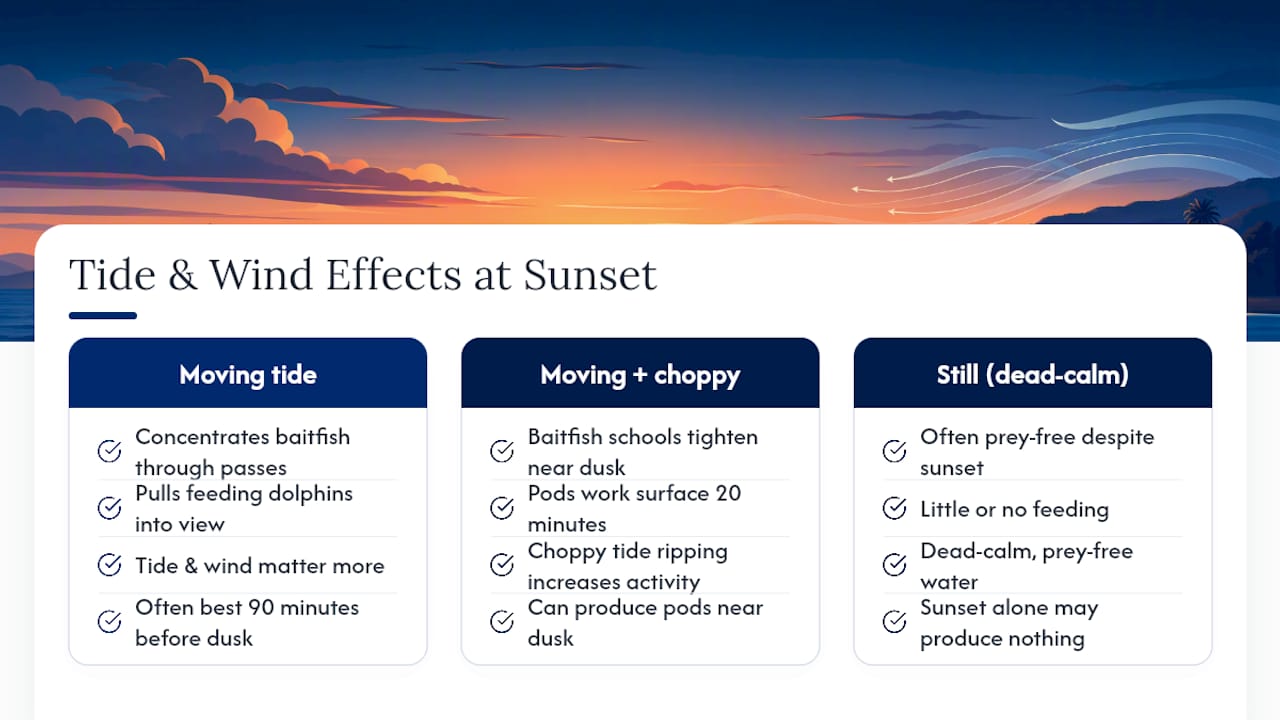
Pro Tip: Check a tide chart for your local pass or inlet before you check the sunset time. A moving tide 90 minutes before dusk often beats a still one right at golden hour.
What’s the Best Time to Book a Sunset Dolphin Tour?
Morning trips generally offer calmer seas and clearer water, which some photographers actually prefer for stability and reduced glare. Sunset trips trade a bit of that calm for better light, longer shadows, and often lighter boat traffic once the day-trippers head in. Neither window beats the other outright. It depends on what you’re optimizing for, tack-sharp clarity or dramatic color.
Before booking, run through this short checklist:
Tide phase: Look for an incoming or outgoing tide during your window, since moving water pushes bait through passes that dolphins follow.
Wind speed: Forecasts pushing past 15 knots usually mean choppier conditions and reduced visibility, so calmer days after a stretch of onshore wind tend to produce clearer water.
Recent weather: A string of calm days after a storm often clears up murky water faster than a single quiet afternoon.
Departure timing: Aim to be on the water 60 to 90 minutes before sunset and stay through early dusk, catching both peak light and the tail end of the late-afternoon activity window.
Where Dolphins Tend to Show Up Most
Dolphins don’t spread evenly across open water. They cluster wherever the geography concentrates their food, which means certain features consistently outperform the open sound or gulf.
Tidal creeks, estuary mouths, marked channels, and shoal edges near marsh grass act as natural funnels for baitfish. When the tide pushes through one of these corridors, it compresses prey into a tighter space, and dolphins key in on that easy meal. A pass between a barrier island and the mainland, for example, often produces more consistent activity at dusk than a stretch of open beach a mile away, simply because of how water moves through it.
Regional geography and season shift which specific corridors are productive at any given time, so a spot that’s reliable in June might be quiet in November. That’s why generic “top ten sunset hotspots” lists age poorly. A better approach is asking a local captain which channel or shoal is holding bait that week, or checking a local marine life guide for the current season’s patterns before you assume last month’s hotspot still applies.
How Do You Photograph Dolphins in Low Light?
Fast-moving subjects and fading light are a tough combination, but a few adjustments make a real difference.
On a dedicated camera, prioritize shutter speed first. Aim for at least 1/1000th of a second to freeze a breach or a fin slicing the surface, since sunset light drops fast and blur ruins more dolphin shots than any other single mistake. Open your aperture as wide as your lens allows (f/4 or lower) to let in more light without dragging your shutter speed down, and let ISO climb into the 800 to 3200 range rather than sacrificing shutter speed for a cleaner image. Shoot in burst or continuous mode. Dolphins surface for a second or two, and a single-shot approach means missing most of what happens.
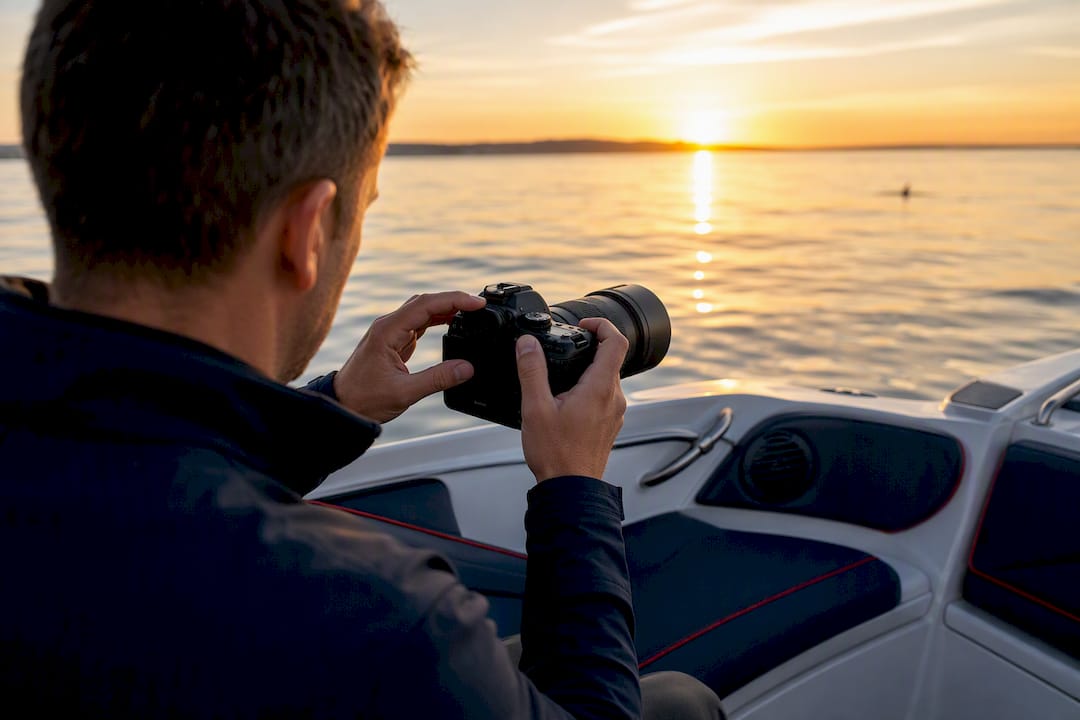
Smartphones need different tricks. Lock exposure and focus by pressing and holding on the horizon or water surface, not the sky, or your dolphin will disappear into a silhouette you didn’t intend. Use burst mode (holding the shutter button on most phones) to catch the actual moment of a splash. Skip HDR at sunset. It tends to flatten the warm color and contrast that make these shots work in the first place, and if your phone has a telephoto lens, use it to avoid cropping into a blurry mess later.
Composition-wise, the last 20 to 60 minutes before sunset produces the strongest backlit silhouettes and long shadows on the water. Keep the horizon low in the frame to give the sky and its color room to breathe, and stay ready. Bow riding and surface breaches happen without warning.
Watch the water ahead of the boat, not just beside it. Bow-riding dolphins often appear first as a shadow underwater before they surface.
Keep both hands on your gear near the rail. A sudden wake or turn happens fast on a moving boat.
Never lean over the rail for a better angle. No photo is worth it.
Pro Tip: Set your camera or phone up before the boat leaves the dock. Fumbling with settings once dolphins appear means missing the shot entirely.
What Happens on a Sunset Dolphin Cruise?
Most sunset dolphin tours run 90 minutes to two hours, departing roughly 90 minutes before sunset so guests are on the water through peak golden hour and into early dusk, similar to a sunset whale watching cruise on Magnetic Island. Operators typically list a handful of quick details up front: trip duration, minimum age (often open to all ages on private charters, with some group tours setting a minimum), and a price range per person or per boat.
A typical itinerary involves cruising known tidal corridors and channels first, then slowing to a drift once the captain spots activity or reaches a promising stretch of water. Expect a few extended pauses for photos and viewing rather than constant motion, plus a return to the dock shortly after the sun drops below the horizon.
Every reputable operator will tell you the same thing: dolphins are wild, and no trip comes with a sighting guarantee. What separates a good operator from a mediocre one is how they stack the odds, checking tides, watching for bird activity that signals baitfish, and adjusting the route in real time rather than running a fixed loop regardless of conditions.
Pack light layers since it cools quickly on the water after sunset, bring water, and take any seasickness precautions beforehand if you’re prone to it. Arrive at the dock at least 15 minutes early so the crew can brief you and get moving on schedule.
How to Pick a Responsible Sunset Dolphin Tour
The operator you choose matters almost as much as the conditions. A few direct questions separate the ones who know the water from the ones running a generic loop.
Ask how they plan routes: real operators reference tide phase and recent bait activity, not just a fixed sunset departure time.
Ask about captain experience and licensing, and how long they’ve worked these specific waters.
Ask whether private charters are available and what the maximum guest count is on any boat you’re considering.
Ask about the cancellation and weather policy before you pay a deposit.
Red flags are easy to spot once you know what to look for. Walk away from any operator promising guaranteed close encounters, offering to feed wild dolphins to draw them in, or packing more guests onto a boat than feels comfortable for actual viewing space. Feeding wild dolphins alters their natural behavior and is broadly discouraged by marine wildlife guidelines for good reason.
Trust signals run the other direction: a licensed captain, a clearly stated ethical wildlife policy, defined safety rules for passengers, and a track record of responsible small-group tours instead of high-volume group runs.
Why a Private Sunset Charter Often Wins
A private, captain-led charter gives you something a large group boat simply can’t: total flexibility around the tide, not the clock. Experienced captains time departures and adjust routes to match tidal corridors and bait concentrations rather than sticking to a fixed schedule, and that flexibility alone tends to produce better sightings.
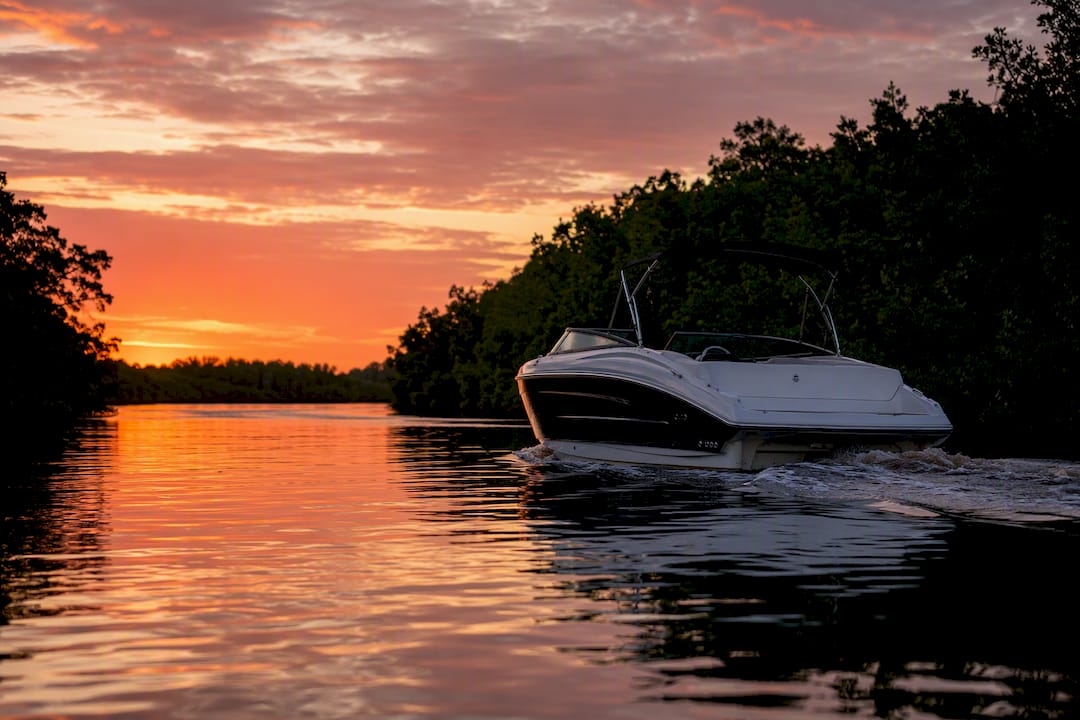
Smaller groups also mean better angles for everyone on board, quieter approaches that don’t spook nearby pods, and a pace that can slow down or linger exactly when something interesting happens instead of rushing to a fixed stop on a group itinerary. PCB Prestige’s private tours run this way by design, built around a smaller boat and a licensed local captain rather than a packed group schedule.
Keeping Sunset Trips Safe for You and the Dolphins
Good etiquette on a sunset dolphin trip protects both the people on board and the animals you came to see. Federal guidelines under the Marine Mammal Protection Act generally recommend staying at least 50 yards from wild dolphins and never chasing, touching, or attempting to swim directly at one. A responsible captain will maintain that distance and let dolphins approach the boat on their own terms rather than closing the gap aggressively.
Noise matters more than most guests expect. Loud engine throttling, shouting, or banging on the hull can scare off a pod that was otherwise comfortable nearby. Staying reasonably quiet once dolphins appear, and letting the captain cut the engine to idle or drift, keeps them around longer and gives everyone a better view.
Feeding wild dolphins is never appropriate, no matter how tempting it feels in the moment. It trains them to associate boats with food, which increases the risk of injury from propellers and changes natural foraging behavior long term. A trustworthy operator will explicitly prohibit it and explain why.
For passengers, the basics still apply: keep hands and loose items inside the boat, stay seated during any sudden movement, wear the life jacket if conditions call for it, and never lean over the rail chasing a photo. A calm, quiet boat that respects distance almost always sees more dolphin activity than a loud one crowding the water, not less.
Do Dolphin Sightings Change by Season at Sunset?
Sunset dolphin activity isn’t identical year round. Warmer months typically bring more consistent baitfish activity close to shore, which tends to translate into more frequent and prolonged sightings during evening cruises. Cooler months can still produce excellent trips, but activity may shift further into channels and deeper passes as baitfish move with water temperature.
Local geography plays into this as much as the calendar. A pass that’s productive every evening in July might quiet down by late fall as prey patterns shift elsewhere, while a different channel picks up the slack. This is part of why a fixed “best months” list only tells part of the story. The tide and recent weather in a given week often matter more than the general season.
What stays consistent is the light itself. Golden hour looks essentially the same in March as it does in August, so even in a slower season for sightings, the photographic payoff of a sunset trip rarely disappoints. Booking during peak season simply stacks the odds a little further in your favor on top of that reliable light.
How Does Dolphin Behavior Shift as the Sun Goes Down?
As daylight fades, dolphins often become more active on the surface rather than less. Feeding tends to intensify in the last hour or two before dark, since many prey species move toward the surface or into shallower water as light drops, and dolphins follow that shift. Surfacing frequency can noticeably increase during this window compared to the flatter, more submerged behavior common under bright midday sun.
Social behavior often becomes more visible too. Pods that were spread out and diving deep during the day sometimes regroup near the surface at dusk, making tail slaps, bow riding, and even occasional breaches more likely to catch on camera. None of this is guaranteed on any single evening, but the pattern holds often enough that experienced captains plan around it rather than treating it as coincidence.
Once true dusk sets in and light drops further, sightings generally taper off, not because dolphins disappear, but because visibility does. That’s the practical argument for treating the 60 to 90 minutes before sunset, plus a short window after, as the real target rather than sunset itself.
When Should You Book a Sunset Dolphin Tour?
Sunset slots are among the most requested times on any given day, especially during warmer months and weekends, so booking a few days to a week ahead gives you the best shot at your preferred date and time. Last-minute bookings do happen, but they limit your options if a specific evening or a private charter is what you want.
Ask about the cancellation and weather policy before you pay anything. Reputable operators typically offer a full reschedule or refund if conditions turn unsafe, since a rough sea state on the day of your trip isn’t something either of you can control. Get that policy in writing or clearly stated on the booking page rather than assuming it.
If you’re set on a specific date, like an anniversary or the last evening of a trip, book earlier rather than later and confirm the departure time a day or two out, since sunset times shift slightly through the season and a good operator will adjust the schedule accordingly rather than sending you out too early or too late.
A Captain’s Take on Sunset Timing
Some of the best sightings happen when the tide is ripping through a pass right as the light turns gold, not necessarily at the exact minute of sunset. A memorable evening usually comes down to reading the water an hour earlier, not luck. Ask your captain which tide they’re planning around and why. That one question tells you more about your odds than any sunset time on a schedule.
See More Dolphins with a Private Sunset Charter
A large group boat runs a fixed loop on a fixed schedule, whether the tide is right or not. A private charter doesn’t have that constraint. Pcbprestige builds each sunset trip around the actual tide and bait activity that evening, with a licensed local captain who can change course the moment gulls start diving or a pod surfaces nearby, something a 40-passenger boat simply can’t do.

PCB Prestige offers one private 3-hour tour for up to six guests at $450 plus tax per group. Choose dolphin watching, Shell Island beach time and shell hunting, snorkeling when conditions and water clarity allow, or a combination with Captain Justin. The final departure of the day is the sunset option; confirm seasonal timing before booking.
Sources
For general timing and tide guidance, see dolphin activity patterns and tide-based sighting tips. For local tour planning, check dolphin watching season tips.
Recommended
Comments