Dolphin Identification: A Field Guide for Observers
- PCB Prestige

- 4 days ago
- 12 min read
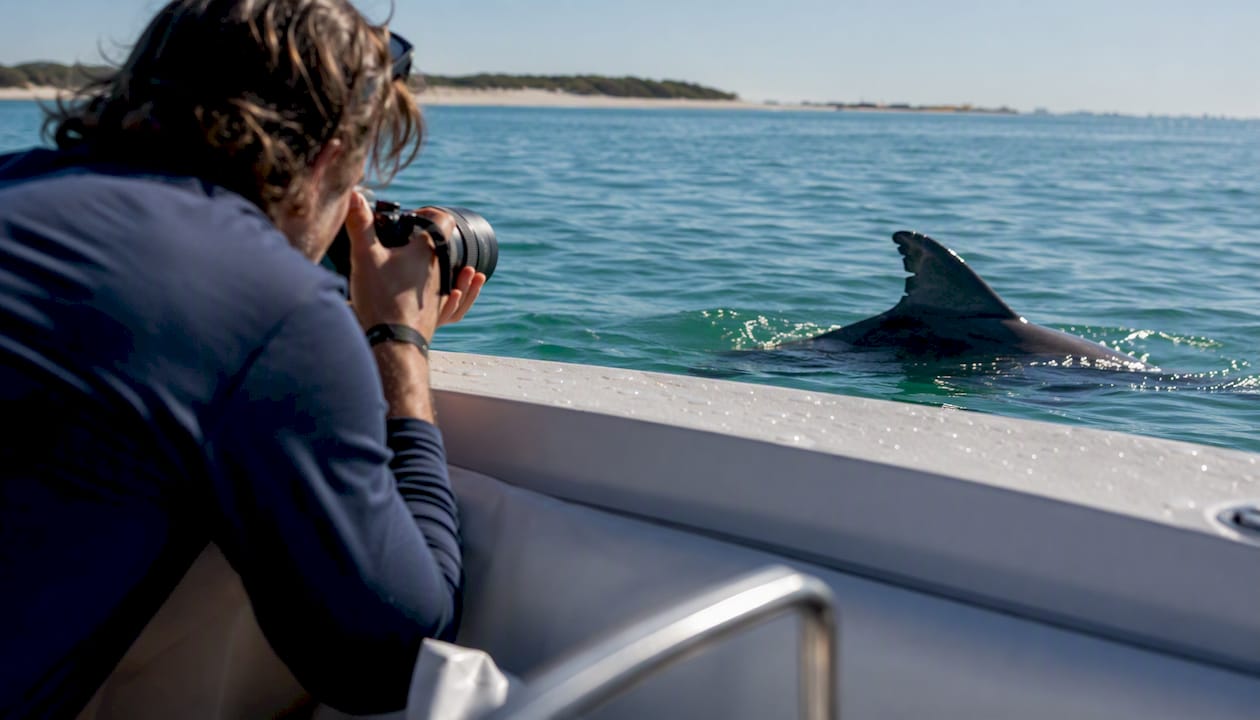
You can identify a dolphin species and a specific individual using two separate methods: species-level field marks (beak length, body shape, color pattern, dorsal-fin shape) and photo-identification of the dorsal fin’s unique nicks, notches, and scars. Researchers confirm that high-resolution side-profile dorsal-fin photos are the gold standard for tracking individuals over time. Both approaches work together — you classify the species first, then pin down the individual.
Before your next sighting, run through this checklist:
Capture a clear side-profile dorsal-fin photo — parallel to the animal’s flank, not from above or at an angle
Note date, time, and GPS location immediately after the encounter
Log group behavior and composition (how many animals, any calves, what they were doing)
Check species field marks — beak length, body size, color pattern, and dorsal-fin shape
For species-level verification, the FAO cetacean identification guide is the authoritative reference. For individual matching and submission, programs like GoMDIS (Gulf of Mexico Dolphin Identification System), the Sarasota Dolphin Research Program, and OBIS-SEAMAP are the primary databases accepting public sighting reports.
Key Takeaways
Dorsal-fin photo-ID, combined with accurate species field marks and behavioral notes, is the most reliable method for both classifying and individually tracking wild dolphins.
Point | Details |
Species field marks | Use beak length, dorsal-fin shape, body size, and color pattern to classify species before attempting individual ID. |
Dorsal-fin photo-ID | Photograph the trailing edge of the fin in a parallel side-profile shot — nicks and notches are stable, long-term identifiers. |
Camera basics | Shoot at 1/1000 sec or faster in continuous burst mode; position the boat broadside with the sun behind you. |
Behavior and group notes | Record behavior state, group size, and calf presence — these notes increase the scientific value of every photo submission. |
Ethics and reporting | Stay at least 50 yards from animals and submit your best photo with full metadata to GoMDIS, OBIS-SEAMAP, or a regional catalog. |
Pcbprestige tours | Private, captain-guided charters in Panama City Beach offer ethical viewing distances and optimal boat positioning for ID-quality photos. |
Table of Contents
Dolphin identification by species: reading field marks from a distance
Photo-ID for individuals: dorsal-fin anatomy and the matching workflow
How behavior and group composition strengthen a sighting report
Ethical viewing, safe distances, and the real limits of photo-ID
Private dolphin tours built for ethical observation and better photos
Authoritative resources for dolphin ID and sighting submission
Dolphin identification by species: reading field marks from a distance
Species-level dolphin identification comes down to five physical features you can assess from a boat or shore, even at a distance. The FAO species identification guide organizes these into diagnostic categories: beak/rostrum length, dorsal-fin shape and position, overall body size and silhouette, color patterns, and distinctive markings like stripes or patches.
The five primary field marks:
Beak/rostrum: Long and narrow (spinner, striped, common dolphin) vs. short and stubby (Risso’s, pilot whale) vs. moderate (bottlenose)
Dorsal-fin shape: Falcate (curved back) and tall vs. triangular and upright vs. small and rounded; position on the back also varies
Body size: Ranges from roughly 4 feet (Hector’s dolphin) to over 12 feet (Risso’s, orca)
Color pattern: Hourglass or crisscross patterns (common dolphin), uniform gray (bottlenose), white-scarred gray (Risso’s), spotted (Atlantic/pantropical spotted)
Distinctive markings: Rostrum tip color, eye patches, cape patterns, and flank stripes
The table below summarizes the most useful diagnostic features for four common groups you are likely to encounter in coastal and offshore waters, including general ranges and typical appearance.
One honest limitation: many species overlap in range, and juveniles often lack the adult markings that make ID straightforward. When lighting is poor or the animal surfaces briefly, record “probable bottlenose” or “unidentified small dolphin” rather than forcing a label. Misidentified sightings in a database cause more harm than an honest “unknown.” For bottlenose dolphins specifically in Gulf Coast waters, the robust body, moderate beak, and tall falcate fin are usually enough to confirm the species at a glance.
Statistic callout: The FAO cetacean identification guide covers more than 80 cetacean species, providing beak measurements, fin diagrams, and color-pattern descriptions for each — a scope no field observer can memorize, which is exactly why carrying a reference (digital or printed) matters.
Photo-ID for individuals: dorsal-fin anatomy and the matching workflow
The dorsal fin is to a dolphin what a fingerprint is to a person. Photo-identification works because the trailing edge of the fin accumulates nicks, notches, and scars over a lifetime, and those features stay stable for years. The leading edge and tip matter too, but the trailing edge is where most reliable marks concentrate.
Dorsal-fin vocabulary every observer should know:
Leading edge: The forward-facing slope of the fin
Trailing edge: The rear-facing slope — where nicks and notches are most diagnostic
Tip: The apex of the fin
Base: Where the fin meets the back
Notch: A V- or U-shaped cut into the trailing edge
Nick: A small chip or indentation, shallower than a notch
Rake marks: Parallel scratches from another dolphin’s teeth — these fade and are not reliable for long-term ID
When dorsal-fin features are ambiguous, shark-bite scars, fluke damage, or persistent skin lesions can supplement the match — but treat them as secondary evidence, not primary.
The standard photo-ID matching workflow:
Capture a clear, parallel side-profile shot of the dorsal fin (both left and right sides if possible)
Record metadata immediately: date, time, GPS coordinates, water conditions, and group size
Crop and standardize the image so the fin fills most of the frame; rotate if needed so the fin is vertical
Compare to a catalog — start with the trailing-edge region and match the overall fin outline before looking at individual marks
Assess match quality — a reliable match requires at least two or three independent features in the same fin region, consistent across photos taken at a similar angle
Submit or log as a confirmed resighting (with the individual’s ID number) or as a potential new individual
Photo catalogs organize fins by region and shape, then assign each confirmed individual a number or name. That system prevents double-counting and lets researchers build life-history records spanning decades. Some projects now use automated fin-matching software to speed the initial search, but human verification remains critical because lighting and angle differences generate false positives.
Pro Tip: Dolphins often surface in a predictable rhythm during traveling or resting behavior. Watch for two or three surfacings to establish the pattern, then pre-focus on the spot where the fin will appear next. That half-second of anticipation is what separates a sharp trailing-edge shot from a blurry tail splash.
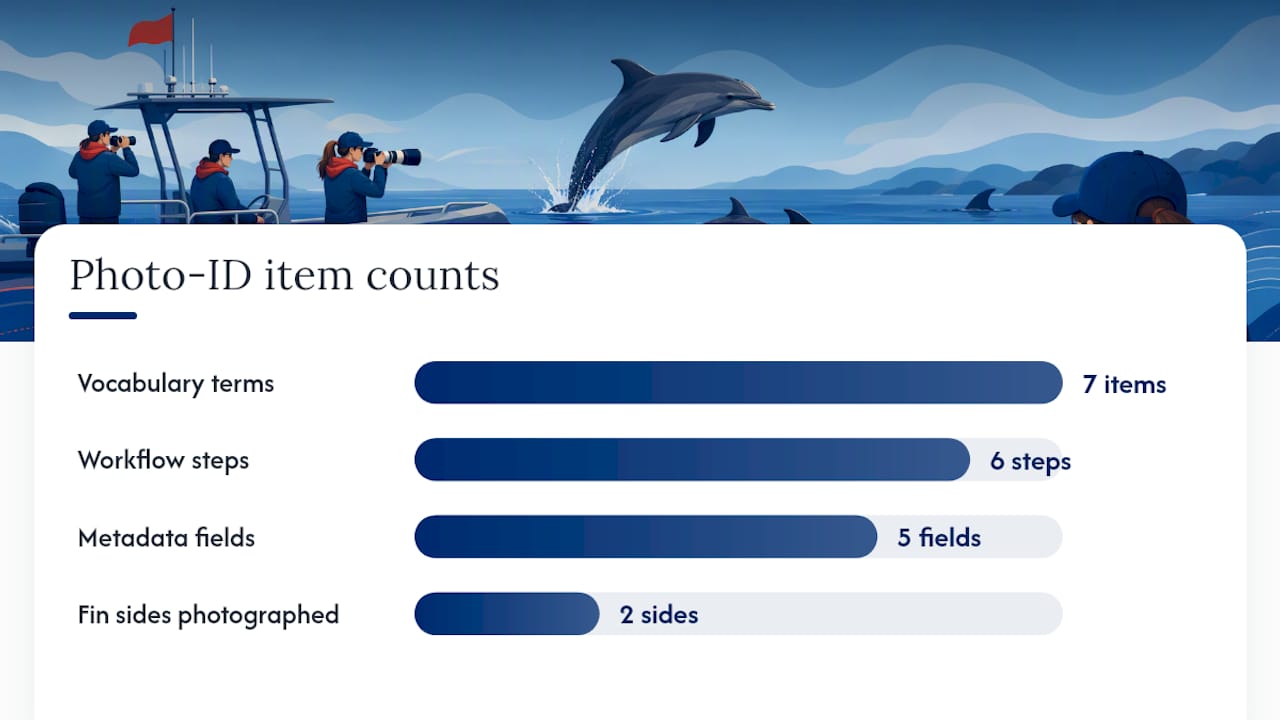
Practical photography tips for capturing usable ID shots
The single most important rule: shoot parallel to the animal’s flank. A photo taken from above or at an angle distorts the fin’s true outline and makes catalog matching unreliable. Researchers are explicit that only clear, parallel side-profile images are scientifically useful for dorsal-fin matches.
Recommended camera settings:
Shutter speed: 1/1000 sec or faster — the fin clears the water in under a second, and motion blur kills the detail you need
Aperture: f/5.6–f/8 to keep the fin sharp without sacrificing too much light
ISO: Start at 400–800; push higher in low light rather than slowing the shutter
Drive mode: Continuous burst (at least 5–8 frames per second) so you capture the full surfacing sequence
Autofocus: Continuous AF (AI Servo on Canon, AF-C on Nikon/Sony) tracks the moving fin better than single-shot modes
For smartphones, enable burst mode and use a telephoto clip-on lens if available. Optical image stabilization helps, but nothing replaces a fast shutter setting.
Field tactics:
Position the boat so the sun is behind you and the animal is broadside — this eliminates backscatter and gives you the cleanest fin silhouette
Anticipate, don’t chase — repositioning the boat mid-surfacing sequence almost always results in missed shots and disturbed animals
Shoot both sides of the fin when the dolphin changes direction; left and right profiles are cataloged separately in most databases
Avoid shooting into glare — polarized sunglasses help you track the animal; a lens hood reduces flare in the frame
Post-processing checklist:
Crop tightly so the fin fills 60–70% of the frame
Adjust contrast slightly to bring out trailing-edge detail
Add date, location, and group-size annotations before saving
Save a full-resolution original alongside the cropped version
Pro Tip: When shooting from a moving boat with a telephoto lens (200mm or longer), brace your elbows against your body or the gunwale and use the lens’s image stabilization on its “panning” mode. The combination cuts camera shake dramatically without slowing your tracking speed.
How behavior and group composition strengthen a sighting report
Behavior context does two things: it sometimes aids species identification directly, and it always increases the scientific value of a photo-ID submission. Researchers use four standard behavior categories — socializing, feeding/foraging, milling/resting, and traveling — and expect observers to record which one applies.
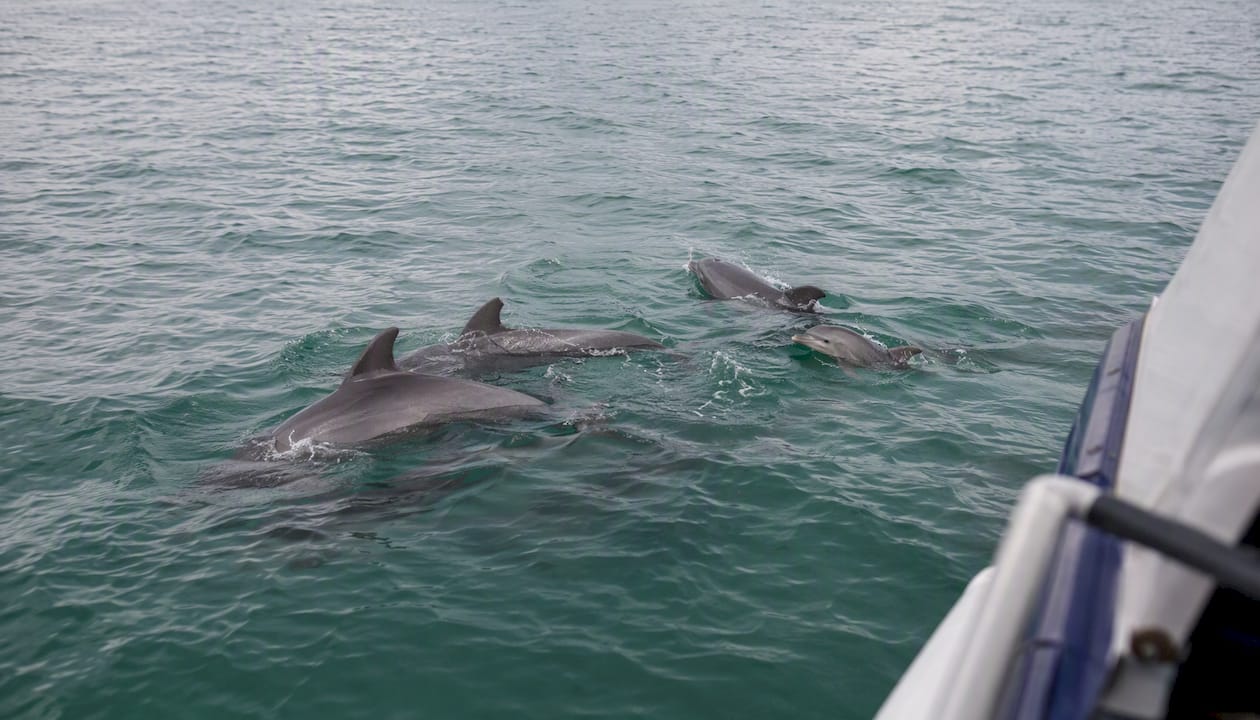
Certain behaviors make identification easier. Resting or milling animals surface slowly and predictably, giving you repeated clean looks at the dorsal fin. Calves stay close to their mothers and surface in sync, which helps you photograph both individuals in the same sequence. A tight, stable group composition also means you can work through the pod systematically rather than chasing random surfacings.
Other behaviors complicate things. Fast chases during feeding, dense bait balls with multiple species mixed together, and aerial behaviors like spinning or breaching all reduce your chances of a clean side-profile shot. Log what you see anyway — even a note that says “active feeding, poor photo conditions” gives a researcher context for why your images are limited.
Group-composition notes to capture at every sighting:
Total number of animals (estimate a range if the group is large)
Number of calves or juveniles visible
Any obvious size or color differences suggesting age or sex
Whether the group was mixed with other species
Direction of travel or focal activity
These notes pair with your photos to create a complete sighting record. A photo without behavioral context is useful; a photo with a full behavioral log is significantly more useful to a population study. For more on dolphin communication and social behavior and how it connects to what you observe in the field, that background helps you interpret what you’re watching.
Dolphins vs. porpoises: a quick visual comparison
Confusing a dolphin with a porpoise is one of the most common misidentifications in coastal waters, and the distinction matters for accurate reporting. NOAA Fisheries lays out the differences clearly: dolphins have longer beaks, falcate (curved) dorsal fins, and more social, vocal behavior, while porpoises have shorter faces, triangular dorsal fins, and tend to be shyer around boats.
Visual and behavioral comparison:
Beak: Dolphins have a distinct, elongated rostrum; porpoises have a rounded, blunt face with almost no beak
Dorsal fin: Dolphins’ fins curve backward (falcate); porpoises’ fins are roughly triangular and upright
Teeth: Dolphins have conical teeth; porpoises have spade-shaped teeth (rarely visible in the field, but useful for stranded animals)
Body shape: Dolphins are generally sleeker and more streamlined; porpoises tend to be stockier relative to their length
Group size: Dolphins often travel in larger, more active groups; porpoises are typically seen alone or in pairs
Behavior near boats: Dolphins frequently bow-ride and approach vessels; porpoises usually avoid boats and surface quietly
Quick field rule: If the animal bow-rides your boat and you can see a distinct beak, it’s almost certainly a dolphin. A shy, blunt-faced animal that surfaces once and disappears is more likely a porpoise.
In North American coastal waters, the harbor porpoise (Phocoena phocoena) is the species most often confused with small dolphins. Its small triangular fin and lack of a beak are the fastest diagnostic features at sea.
Where to submit your photos and sighting data
A good photo sitting on your phone helps no one. These programs accept public sighting reports and have clear submission processes.
Major programs and what they accept:
GoMDIS (Gulf of Mexico Dolphin Identification System): Run by the Sarasota Dolphin Research Program, GoMDIS aggregates dorsal-fin photos and sighting data from across the Gulf of Mexico. Submit photos with date, location, and behavioral notes through their online portal. The database supports ranging-pattern studies and stranding origin analysis.
Sarasota Dolphin Research Program: One of the longest-running cetacean studies in the world, with a photo catalog spanning decades. Contact them directly for Gulf Coast submissions outside the GoMDIS portal.
OBIS-SEAMAP (Ocean Biodiversity Information System Spatial Ecological Analysis of Megavertebrate Populations): A global aggregator for marine mammal sighting data. Accepts georeferenced sighting records and supports large-scale distribution mapping. Useful for observers outside the Gulf region.
Dolphin Research Australia: Maintains a public dolphin identification guide and sighting network for Australian waters, with a model submission workflow that other regional programs follow.
Regional and local projects: The Irish Whale and Dolphin Group’s Shannon Dolphin Project and similar regional catalogs accept submissions from their specific study areas. Check for a program covering your local coastline before defaulting to a global database.
Submission checklist:
Your single best photo (sharpest, most parallel side-profile)
Date, time, and GPS coordinates (or nearest landmark)
Number of animals and calves
Behavioral state at time of sighting
Your contact information for follow-up
After submission, response times vary by program. GoMDIS and similar regional catalogs typically confirm receipt within a few weeks; a catalog match or new-individual assignment may take longer depending on researcher workload. If your animal matches an existing catalog entry, you may receive the individual’s ID number and, in some programs, a brief life-history note. That feedback loop is one of the most rewarding parts of contributing to citizen science. Educational boat experiences designed around marine observation can also prepare first-time contributors to collect better data before they ever submit a photo.
Ethical viewing, safe distances, and the real limits of photo-ID
NOAA recommends staying at least 50 yards from dolphins in the wild, and that distance is both an ethical standard and a scientific one. Close approaches alter dolphin behavior, which biases observational data and can interrupt feeding, nursing, or resting. Ethical viewing is not a soft preference — it is a condition for collecting data that is actually useful.
Ethical checklist for boaters and swimmers:
Maintain at least 50 yards of distance; increase to 150 yards for mother-calf pairs
Never enter the water to chase or intercept dolphins
Reduce speed and avoid sudden course changes when animals are nearby
Do not feed dolphins — it changes their behavior and is illegal under the Marine Mammal Protection Act
Report stranded or injured animals to NOAA’s stranding hotline or local marine mammal rescue organizations, not to social media first
Photo-ID also has genuine technical limits that honest observers should understand. Fins change over time as animals acquire new injuries or old rake marks fade. A photo taken at a slight angle can make a fin look notched when it is not, or hide a real notch entirely. Some species — particularly offshore pelagic dolphins seen briefly — are simply too hard to match reliably from a single encounter.
Pro Tip: Keep a running log of every sighting, even when your photos are poor. A series of imperfect images from repeated encounters in the same area, combined with behavioral notes, can still confirm a resighting when no single image would hold up alone.
Practical mitigation: take multiple photos across the full surfacing sequence, note behavior to contextualize the images, and flag uncertain matches as “possible” rather than “confirmed” when submitting. Researchers appreciate honesty about image quality far more than a confident but wrong ID.
Why the photo matters more than most observers realize
There is a gap between what people think they are doing when they photograph a dolphin and what researchers can actually use. Most observers come back from a trip with dozens of shots of dolphins leaping, splashing, or swimming toward the camera. Beautiful photos. Scientifically useless for individual ID.
The trailing edge of a dorsal fin, photographed cleanly from the side, is where decades of research live. The Sarasota Dolphin Research Program has tracked individual bottlenose dolphins for over 50 years using exactly this method; the Shannon Dolphin Project has built multi-decade datasets from photo catalogs submitted by researchers and trained volunteers. Those long-term records answer questions about lifespan, reproduction, social bonds, and population health that no other method can touch.
What that means practically: one sharp, parallel, well-lit dorsal-fin photo submitted with accurate metadata is worth more to a researcher than 50 dramatic action shots. The discipline of shooting for science rather than aesthetics is a real skill shift, and it takes a few trips to internalize. But once you start seeing the fin as the subject rather than the whole animal, your photos become genuinely useful.
The ethical dimension connects directly to the scientific one. An observer who stays at 50 yards and shoots patiently gets better fin photos than someone who chases the pod to 20 yards and spooks the animals into a dive. Distance and patience are not constraints on good photography. They are the conditions for it.
Private dolphin tours built for ethical observation and better photos
If you want to put these techniques into practice with the best possible conditions, a private guided charter removes most of the variables that make field photography difficult.

Pcbprestige’s private dolphin tours in Panama City Beach run on a 26-foot powerboat with a licensed local captain who knows where bottlenose dolphins feed, rest, and travel in St. Andrews Bay and around Shell Island. The private format means no crowd noise, no competing for rail space, and a captain who can reposition the boat for the best broadside angle without disturbing the animals. Groups are capped at six guests, which keeps the boat stable and quiet. Every tour follows NOAA distancing guidelines as standard practice, not an afterthought. For families or small groups who want to collect real ID-quality photos and contribute to local sighting databases, this is a practical way to do it right. Book your private tour and head out with a captain who already knows the local pod.
Authoritative resources for dolphin ID and sighting submission
Resource | What it offers |
Diagnostic species accounts covering beak length, fin shape, color patterns, and tooth counts for over 80 cetacean species | |
Gulf of Mexico photo catalog and sighting database; accepts public dorsal-fin photo submissions with metadata | |
Dolphin Research Australia — ID Guide | Step-by-step photo-ID methodology and public sighting network; model workflow for citizen-science contributors |
Global georeferenced marine mammal sighting database; accepts records from observers worldwide | |
Dolphin Communication Project — Photo-ID FAQ | Explains the photo-ID matching process, catalog structure, and how automated software is used with human verification |
Field comparison of dolphins and porpoises; includes safe-viewing distance guidance and legal context | |
Regional species guide for Panama City Beach and St. Andrews Bay waters, with local sighting context |
Sources
Recommended
Comments