Dolphin Communication: What Science Reveals in 2026

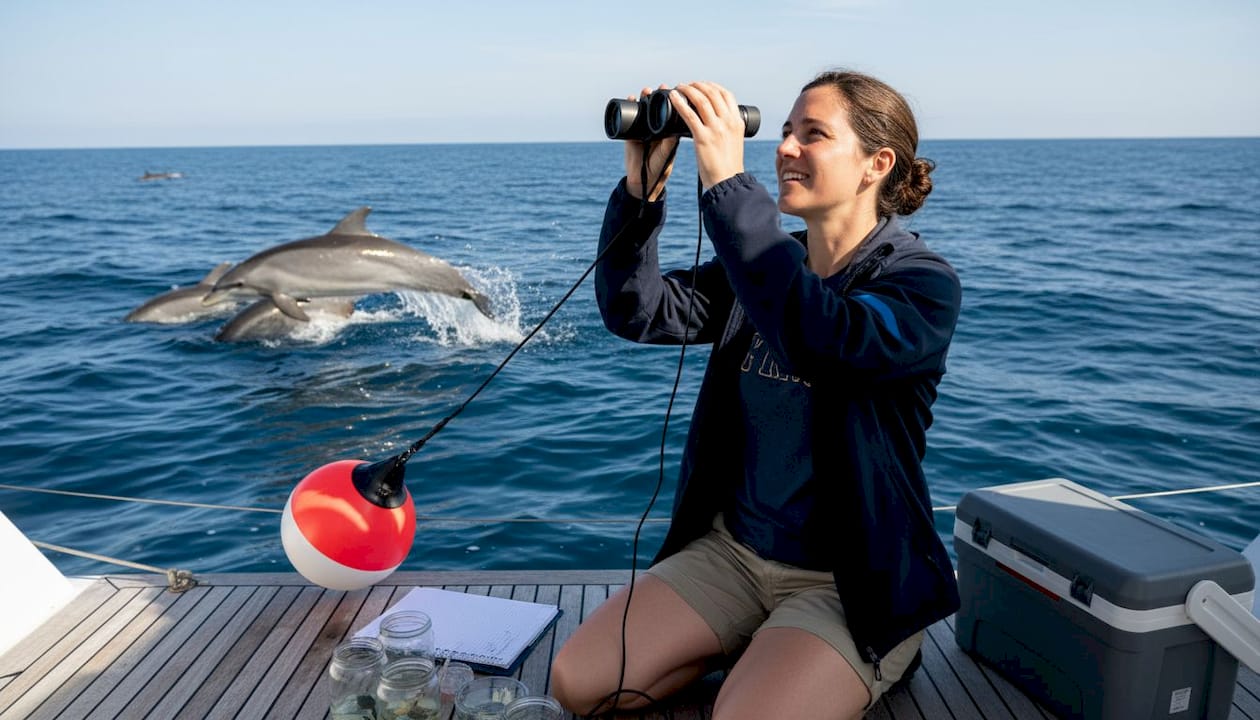
Bottlenose dolphins use whistles, other sounds, movement, and touch during social interactions. Echolocation also helps them locate objects and prey. This article separates research findings from what guests can observe on a private boat tour near Panama City Beach. Studies from other populations offer useful context, but they do not establish the meaning of every local encounter.
What are signature whistles and how do dolphins use them?
Signature whistles are unique identifiers that function like individual names. Each bottlenose dolphin develops its own whistle contour early in life and uses it to announce its presence, maintain contact with group members, and coordinate movement. Signature whistles can help dolphins maintain contact when separated or when visibility is limited.
Playback research shows that the shape of a signature whistle can carry identifying information even when voice features are removed. Recognizing that pattern is different from translating a complete dolphin language.
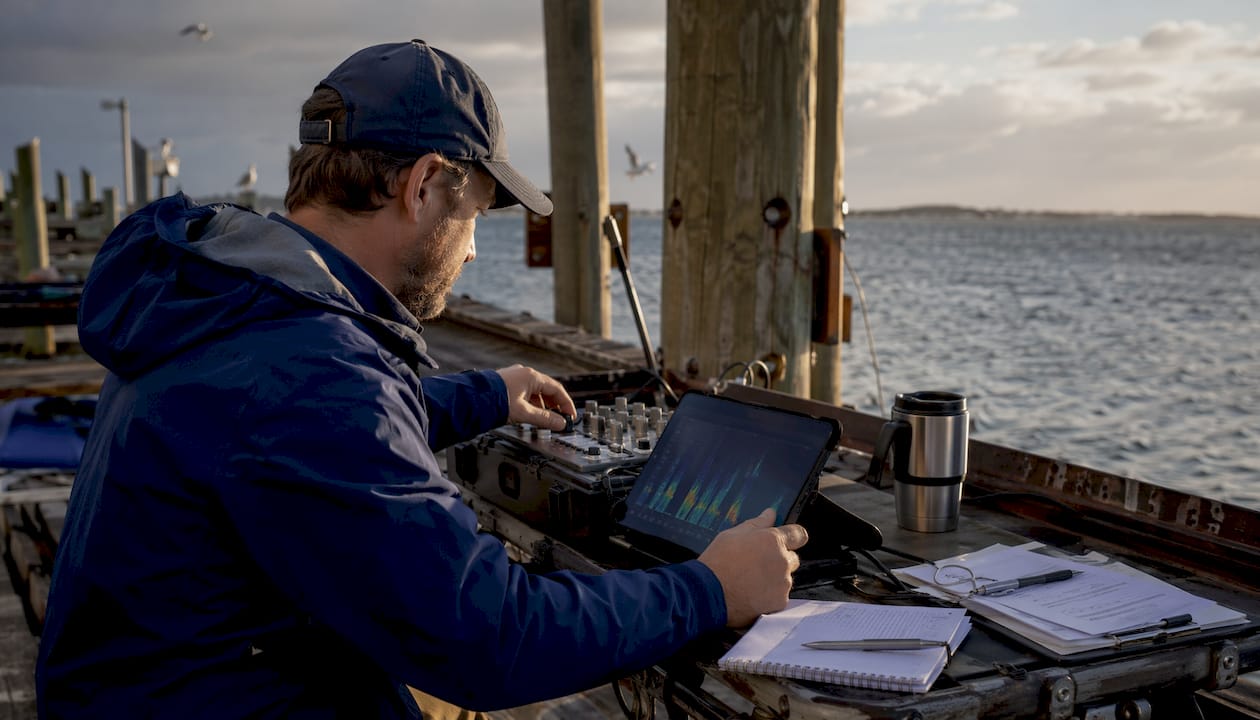
Playback experiments indicate that bottlenose dolphins can respond to copies of their own signature whistles. Researchers describe these whistles as learned vocal labels; the comparison with human names concerns individual identification, not proof of human-like language.
Key functions of signature whistles include:
Individual identification: Each whistle contour is unique to one animal.
Contact maintenance: Dolphins broadcast their whistle when separated from the group.
Social coordination: Whistle copying signals a desire to interact or reunite.
Group cohesion: Whistles help pods stay organized in open water.
Pro Tip: Scientists study signature whistles using hydrophones and spectrograms. A spectrogram is a visual map of sound frequency over time, and it lets researchers identify individual dolphins by the shape of their whistle contour the same way you might recognize a friend’s handwriting.
How do dolphins vocalize and use body language beyond whistles?
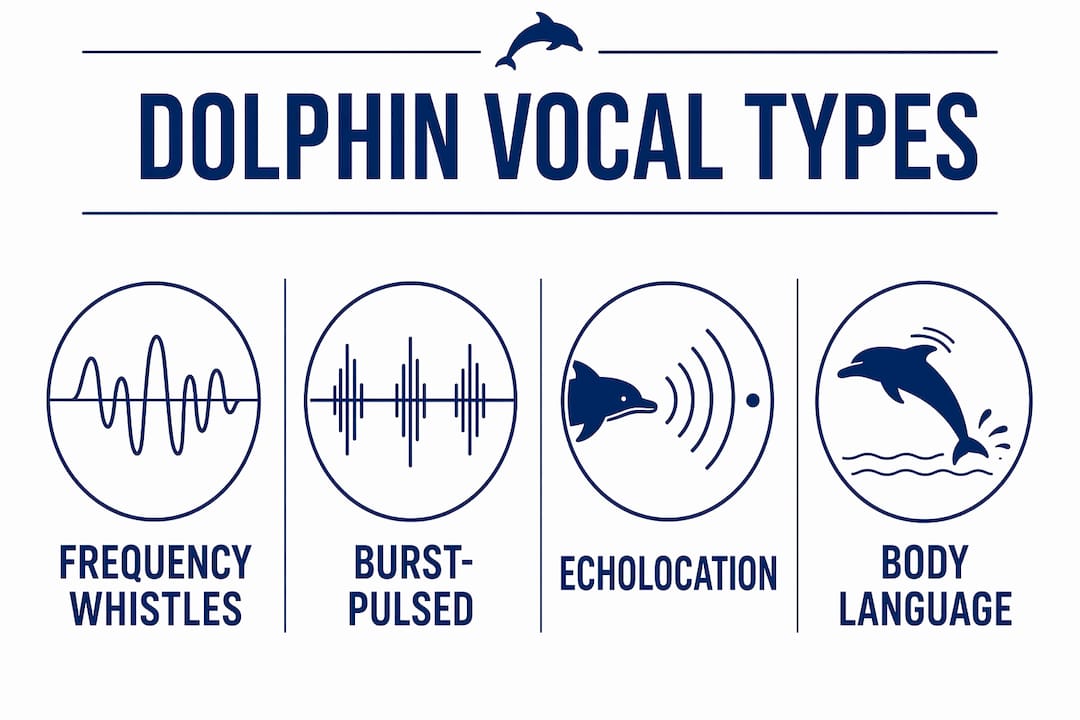
Dolphins produce three main sound types: frequency-modulated whistles, burst-pulsed sounds, and echolocation clicks. Each serves a distinct function. Whistles maintain group cohesion. Burst-pulsed sounds, which are rapid sequences of pulses, handle close-range social interaction, including disputes and courtship. Echolocation clicks navigate the environment and locate prey by bouncing sound off objects and reading the returning echo.
Burst-pulsed sounds and social context
Burst-pulsed sounds occur in social interactions. Their meaning depends on the animals and the surrounding behavior; visitors should avoid assigning a single emotion to a sound or movement.
Body language as a communication layer
Dolphin movements and physical contact provide context for researchers studying social behavior. A tail slap, body roll, or change in posture is not a simple code that visitors can reliably translate from one sighting.
Jaw clapping:A behavior interpreted alongside the surrounding interaction.
Pectoral fin contact:Physical contact that can occur during social interactions.
Tail slapping:A surface strike whose interpretation depends on context.
Body posturing:Movements that researchers study together with other behavior.
Pro Tip: When watching dolphins from a boat, notice their positions and movements. Swimming alongside each other can be part of social behavior, but proximity alone does not establish a family relationship.
What new research reveals about female dolphins and mate choice
A 2026 PNAS study examined Indo-Pacific bottlenose dolphins using 34 sound-playback experiments with 17 females. Reproductively available females reacted more negatively to signals identifying males with higher coercion rates. The findings suggest that individual recognition and prior social experience influence responses. This study should not be treated as direct evidence about dolphins encountered in Panama City Beach.
The result supports an interpretation involving social knowledge, while leaving questions about how that information affects decisions in other populations.
The mate-choice study did not test boat noise. Any claim that noise disrupts these particular reproductive responses needs separate evidence.
How do dolphin mothers communicate differently with calves?
A 2023 study of 19 female common bottlenose dolphins near Sarasota Bay found higher maximum whistle frequencies and wider frequency ranges when mothers were recorded with their dependent calves. Researchers compared this pattern with human child-directed communication, sometimes called motherese.
What the pitch study establishes
The observed pitch changes are evidence of different vocal production in the presence of calves. Attention, bonding, and vocal learning are possible functions proposed by the researchers, rather than benefits directly demonstrated by this experiment.
Communication feature | Without dependent calf | With dependent calf |
Whistle pitch | Standard range | Elevated maximum frequency |
The experiment measured whistle characteristics during health assessments. It did not measure whether pitch changes improve calf survival.
Pro Tip: A smaller dolphin swimming beside a larger one may be a calf with its mother, but size and coordinated movement alone cannot confirm that relationship.
How does the environment shape dolphin communication?
Noise can change dolphin vocal behavior, but louder habitats do not always produce more complex whistles. A 2018 study found higher whistle frequencies and simpler contours as ship noise increased. Researchers suggested that simplification could reduce the identifying information carried by calls.
Responses to noise depend on the study context. Water clarity or a coastal habitat label alone does not establish how complex a dolphin’s whistle will be.
A habitat label alone cannot predict whistle complexity. Research findings should be tied to the conditions actually measured.
The noise study raises concerns about communication, but does not establish a specific effect on the female mate-choice responses described above.
Key Takeaways
Research supports individual recognition through signature whistles and context-dependent changes in vocal behavior. Observing dolphins from a boat is different from measuring their calls or identifying the purpose of an interaction.
Point | Details |
Signature whistles act as names | Each dolphin has a unique whistle contour used for individual recognition and contact. |
Females use vocal memory for mate choice | A 2026 Indo-Pacific bottlenose dolphin study found stronger negative responses to signals identifying more coercive males. |
Mothers modify calls for calves | A Sarasota study found pitch changes with calves present; bonding and learning functions remain hypotheses. |
Noise can alter calls | A 2018 study found simpler contours under increased ship noise; responses depend on context. |
Communication is multimodal | Vocalizations, body posture, and touch work together and cannot be understood in isolation. |
Watching dolphin behavior responsibly
On a dolphin tour near Panama City Beach, leaps and bow riding are only the visible part of the encounter. Much of dolphin communication happens underwater, beyond what visitors can observe from a boat.
Long-term research helps scientists connect vocal signals with known individuals and their social relationships. A brief sighting from a tour boat cannot provide the same evidence.
Signature-whistle research offers a useful way to understand individual recognition. Visitors should distinguish these research findings from guesses about a particular dolphin encounter.
For families and educators, the practical takeaway is to observe carefully and ask questions. Similar size, movement, or proximity does not establish an animal’s identity or relationship to another dolphin.
Observe dolphins respectfully, follow your captain’s guidance, and avoid chasing or approaching them to provoke a response. Wildlife sightings and specific behaviors are never guaranteed.
Observe dolphins responsibly with PCB Prestige
A tour offers a chance to watch wildlife, while the research summarized here helps explain the limits of what a surface sighting can tell us.

PCB Prestige offers one flexible three-hour private boat tour with Captain Justin, departing Sun Harbor Marina in Panama City. Guests can choose dolphin watching, Shell Island beach time and shell searching, snorkeling, or a combination when conditions allow. The final departure is the sunset tour; confirm seasonal timing before booking. Activities depend on weather, water clarity, and safe conditions. Wildlife sightings are never guaranteed. Captain Justin holds a 50-ton Master captain’s license and PADI Divemaster certification. He has been licensed for about 12 years and has worked on tours for about 10 years.
FAQ
What is a signature whistle in dolphins?
A signature whistle is an individually distinctive vocalization that bottlenose dolphins use to maintain contact and convey identity. Researchers often compare its identifying function to a name.
How do dolphins communicate underwater?
Dolphins communicate underwater using frequency-modulated whistles, burst-pulsed sounds, and echolocation clicks, often combined with body posture and physical touch. Each signal type serves a different social or environmental function.
Can dolphins recognize each other by voice?
Research shows that bottlenose dolphins can extract identity information from the shape of signature whistles even when voice features are removed. This finding supports recognition through learned whistle patterns.
How does noise pollution affect dolphin communication?
Noise can affect dolphin calls. A 2018 ship-noise study found higher frequencies and simpler whistle contours. It did not test whether noise changes mate-choice responses.
Do dolphin mothers communicate differently with their calves?
Yes. In a Sarasota Bay study, females produced higher maximum frequencies and wider whistle frequency ranges with their calves present. Possible benefits for bonding and learning remain hypotheses.
Recommended
Bottlenose Dolphin Swimming in Panama City Beach | PCB Prestige Private Dolphin & Snorkel Tours
Panama City Beach Marine Life Guide | PCB Prestige Private Dolphin & Snorkel Tours
Private Dolphin Tour in Panama City Beach: What to Expect (2026 Guide)
Marine Life in St. Andrews Bay: What You Might See on Your Tour
Comments