What Operators Refund: Panama City Beach Charter Cancellation

Most charter operators will not refund your deposit once you cancel, and refunds shrink fast the closer you get to departure. The one move that protects you is submitting written cancellation before the deadline printed in your contract, then keeping a timestamped copy of it. The main exception works in your favor: if the operator cancels for weather or safety, you’re typically owed a full refund or a rescheduled trip, not a fight.
TL;DR:
Refunds become increasingly limited as cancellation timing moves from more than 30 days to same-day, with no refunds typically available under 48 hours.
Deposits serve as opportunity costs for the operator’s lost booking slot and usually become nonrefundable once the final payment deadline passes.
Weather or safety cancellations by the operator typically qualify for full refunds or rescheduling, while customer-initiated cancellations follow strict tiered penalty schedules.
Written cancellation notices with booking details and timestamped proof are essential to secure valid refunds and disputes, as verbal notices rarely suffice.
Insurance covers unforeseen emergencies but generally does not reimburse cancellations due to personal preference or pre-existing conditions outside specific windows.
Table of Contents
Understanding Charter Cancellation Policy Deadlines and Fee Tiers
Charter operators generally build their cancellation terms around four timing buckets, and where your cancellation falls determines how much money you see again. The pattern shows up across the industry, from small dolphin tour operators to large institutional fleets.
More than 30-45 days out: Full or near-full refund, sometimes minus a small administrative fee.
14-30 days out: Partial refund, often 50% or the deposit amount, depending on the operator.
48-72 hours out: Minimal or no refund. Some operators still return a portion if the boat rebooks in time.
Same-day or no-show: Full charge, no refund, no exceptions.
HooDoo Charters publishes a version of this structure: cancellations made several days before departure may qualify for a refund minus processing fees, but cancellations made close to departure often forfeit the deposit entirely. Charter 1 uses a similar tiered model, with partial refunds available more than a month out, a smaller partial refund inside two weeks, and nothing at all once you’re under 14 days.
Institutional operators can be even stricter. Stanford Transportation’s charter terms hold customers responsible for full payment if they cancel within 120 hours, five full days, of the scheduled charter.
Peak season tightens all of this. A single-vessel operator running one boat a day during summer weekends has no flexibility to fill a canceled slot on short notice, so the “final payment” date in your contract isn’t a formality. Miss it, and you’ve typically converted your deposit into full liability for the trip.
How Deposits, Final Payments, and Refunds Actually Work
A deposit isn’t really a placeholder. It’s compensation for the booking slot the operator turns away once you reserve it. That’s why HooDoo Charters and most operators treat deposits as an administrative fee covering lost opportunity, not a fully refundable hold on your card.
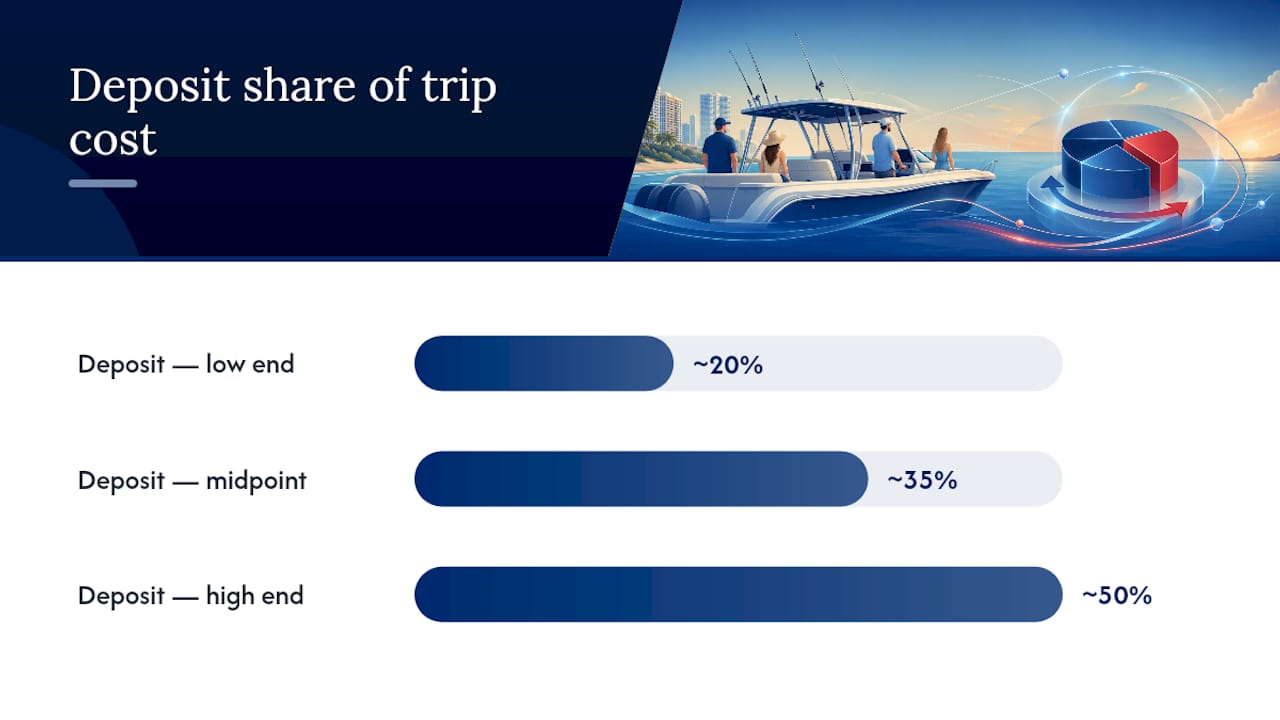
Deposits typically run as either a flat dollar amount or a percentage of the total trip cost, often a portion ranging from about one-fifth to half of the total. Either way, the moment you pass the operator’s final payment date, the deposit’s nature changes. It stops being a reservation fee and becomes the first slice of a nonrefundable balance.
Final payment is the real deadline that matters. Once that date passes, most contracts treat the full remaining balance as due, regardless of whether you show up. This is the same logic behind Stanford Transportation’s 120-hour rule: after that point, the operator has already turned down other business on your behalf, so the financial exposure shifts to you.
When a refund is owed, processing follows a predictable pattern:
Refunds usually return to your original payment method, not as cash or a check.
Processing fees (often a percentage of the transaction) commonly get deducted before the refund posts.
Turnaround time typically runs 5 to 10 business days, though some operators take longer during peak season.
Quick fact: industry guidance around trip protection consistently points to one reality: once you’re past the refund window, insurance, not the operator, becomes the only realistic path to recovering your money for personal emergencies.
Operator-Initiated Cancellations for Weather and Safety
When the operator cancels, not you, the math flips. Stellaris Charter’s policy draws a clear line between customer-initiated cancellations, which carry the tiered penalties above, and weather or safety cancellations, which typically qualify for a full refund or a reschedule.
This distinction exists because the decision isn’t discretionary. Captains generally rely on official local advisories from port or harbor authorities, their own assessment of conditions such as wind and wave height, and safety advisories from relevant coast guard or maritime authorities.
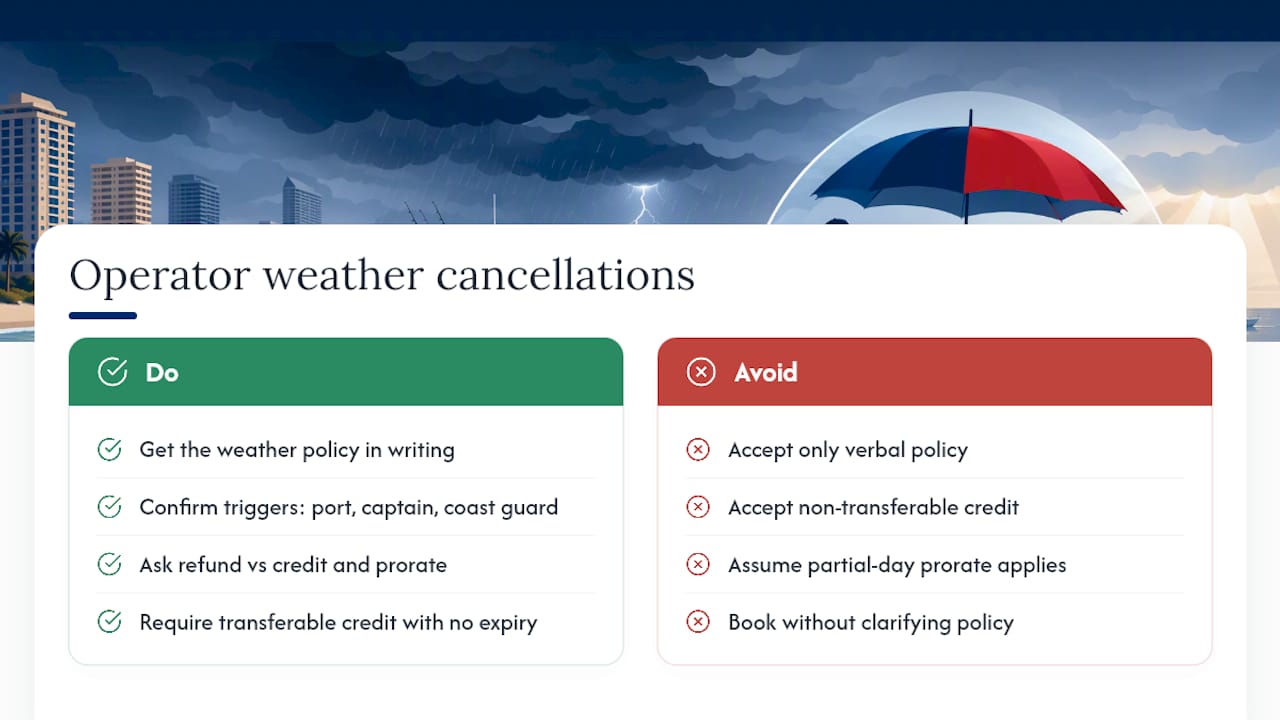
Weather-based refunds are close to universal when a licensed captain or port authority declares conditions unsafe. Where operators vary is on partial-day cancellations, if a trip gets cut short mid charter for safety reasons rather than canceled outright, some prorate the refund and others don’t. Before you book, ask the operator to put their weather policy in writing: what triggers a cancellation, whether you get a refund or a credit, and how long any credit stays valid. If a captain offers rebooking instead of cash back, push for a credit with no expiration and the ability to transfer it to another date or another guest.
Rescheduling and Rebooking: What’s Realistic During Peak Season
Rescheduling sounds simple until you try to do it in July. Operators treat reschedule requests as lower priority than new bookings because a single open slot in peak season usually has three people trying to fill it. A move you assumed would be easy at the time you booked can become impossible six weeks later.
A few steps improve your odds:
Ask for multiple backup dates upfront, not just one alternate day, when you first request a reschedule.
Get on the waitlist immediately if your preferred new date is full. Cancellations happen constantly and waitlists move fast.
Confirm third-party vendor policies separately. Catering, gear rental, and transportation add-ons are frequently nonrefundable once ordered, even if the boat itself reschedules cleanly.
Ask about reschedule fees at booking time, not after you need one. Some operators waive the fee if you rebook within the same season.
Pro Tip: Lock in your flexibility before you pay a deposit. Ask the operator directly: “If I need to move this trip, what’s the process, and is there a fee?” Getting that answer in writing before you book beats negotiating it after a schedule conflict forces your hand.
How to Submit a Valid Charter Cancellation
A phone call to the dock or a text to your captain almost never satisfies the cancellation requirement in your contract, even if someone verbally acknowledges it. HooDoo Charters and most operators require written notice, typically email or a web form, because verbal notices leave no timestamp and no paper trail if a dispute comes up later.
A valid cancellation notice should include:
Your booking reference or confirmation number
The name on the reservation and the date/time of the scheduled charter
A clear statement that you are canceling, not just asking a question
The date and time you’re sending the notice
Cancellation step | Why it matters |
Send written notice (email/form) | Creates a timestamp that starts your refund clock |
Include booking reference | Prevents delays from the operator matching your request |
Save a copy or screenshot | Your proof if a refund dispute or chargeback happens |
Request written confirmation back | Verifies the operator received and processed your cancellation |
Follow up within 48 hours if silent | Protects your position before the deadline passes |
If you don’t hear back within a couple of days, follow up in writing again and reference your original message. Keep every email. If a refund dispute ends up with your credit card company, that timestamped paper trail is what settles it in your favor.
Protecting Your Charter Booking with Insurance
Trip cancellation and curtailment insurance covers scenarios that no operator’s written policy ever will, sudden illness, a family emergency, a canceled flight that strands you before the trip. But these policies come with real exclusions. Pre-existing medical conditions are commonly excluded unless you buy coverage within a specific window after your initial deposit. Simple change-of-mind cancellations are almost never covered, insurance protects against unforeseen events, not preference.
Operator protections and insurance protections solve different problems, and understanding the split matters:
Operator policies cover weather and safety, situations outside anyone’s control on the day of the trip.
Insurance covers personal circumstances, illness, family emergencies, travel disruptions unrelated to the boat itself.
Pro Tip: *Before you finalize a private charter booking, ask the operator two questions in writing: what’s your weather cancellation policy, and are any add-ons (catering, gear rental) separately nonrefundable? Document any medical emergency or official travel restriction immediately, insurers and operators alike respond faster to a dated doctor’s note than a verbal explanation after the fact.
Why Strict Charter Cancellation Rules Actually Make Sense
Operators aren’t being difficult when they hold firm on deadlines. A private charter has one boat, one captain, and one group per slot, so a last-minute cancellation doesn’t free up a seat. It empties the entire vessel for that window, with no way to recover the cost from anyone else.
That’s the real reason deposits exist and final payment dates get enforced, as explained in the Yacht Charter History: Origins, Evolution and Today. It isn’t about punishing customers. It’s about the math of running a business where every trip has exactly one paying group and zero backup revenue if that group doesn’t show. The flip side is real too: legitimate weather cancellations get handled fairly, and a written request almost always gets a straight answer.
— Justin
Booking a Private Charter with Clear, Fair Terms
Some operators run private charters instead of shared group tours, which can simplify cancellation policies by avoiding shared-booking exceptions. You’re not splitting a boat with strangers, so there’s no confusion about whose deposit applies to what.

Operators running a single 26-foot boat per group typically have weather and safety calls made directly by the licensed local captain rather than a call center reading from a script. If conditions turn unsafe, you get a straight conversation about rescheduling or a refund, not a runaround. That transparency extends to booking terms across every trip type, whether you’re looking at the 3-hour private dolphin and snorkeling tour or the 2-hour sunset cruise.
If you’re planning a trip to Panama City Beach and want a cancellation policy you can actually read and understand before you pay a deposit, check available dates and book your private tour online or explore the full range of tour options to find the trip length that fits your group.
Where to Verify Exact Cancellation Terms
Policy language varies by operator, so confirm exact deadlines and fee percentages directly with your provider before booking.
Stanford Transportation’s charter terms for an institutional example of a 120-hour cancellation rule
HooDoo Charters’ refund policy for sample fee tiers and written-notice requirements
Stellaris Charter’s cancellation policy for how weather cancellations are typically handled
Charter 1’s cancellation schedule for a tiered percentage refund example
Sources
FAQ
Why do charter cancellation policies feel so strict?
Charter operators run limited inventory, often a single boat per time slot, so a cancellation can’t be resold like a seat on a bus or a hotel room. The deposit and final payment rules exist to cover the lost slot, not to penalize customers unfairly.
How late can I cancel and still get some money back?
It depends entirely on your operator’s tiered schedule, but most refunds shrink significantly inside the 48 to 72 hour window and disappear entirely for same-day cancellations, as shown in HooDoo Charters’ published tiers.
Do I get a refund if the operator cancels for weather?
Yes, in almost every case. Operators like Stellaris Charter offer a full refund or a reschedule when a captain or port authority declares conditions unsafe, since that decision is outside the customer’s control.
What counts as a valid cancellation notice?
A written email or web form submission that includes your booking reference, the reservation name, and a clear cancellation statement, not a phone call or a text message to your captain.
Does trip insurance cover a canceled charter?
Trip cancellation insurance typically covers illness, family emergencies, and travel disruptions, but it generally excludes simple change-of-mind cancellations and pre-existing medical conditions outside a specific purchase window.
Recommended
Comments